Tuesday, December 20, 2016

Every month there are new headlines about the Royal Bank of Scotland’s wrongdoing. The chief executive, Ross McEwan, puts the best spin on things, but his bank is still failing; most recently it failed the Bank of England’s stress test. Trying to privatise the bank hasn’t worked and state ownership hasn’t been a rip-roaring success either; but worse, its very size and dominance means together with the other big banks it is stifling competition. Now is the right moment for a different approach.

Together as taxpayers we saved the Royal Bank of Scotland – now we should each be allowed to own it. It should become a people’s bank, which every tax-paying British citizen would have the right to become a part-owner of.

The Royal Building Society of Scotland, with an iron lock on its assets, would be a final, decisive break with the Fred Goodwin era. It would conserve the strength and credibility of one of our major financial global players while injecting a much needed dose of competition and diversity into British banking.

More than £45bn of taxpayer funds have been injected into the Royal Bank of Scotland. This was the right thing to do, but neither keeping it as a state bank nor a fully privatised bank offer the same advantages as turning it into a mutual. Its sheer size means it risks being captured again by narrow shareholder interests or those of its senior executives, or both.

Turning it into a mutual with its assets protected from the so-called carpet-baggers who championed building society demutualisation in the 1990s would substantively change the culture at RBS and, crucially, make banking more competitive. In strong mutuals it is member expectations rather than shareholder interests that help to ensure more competitive products and services are prioritised by managers.

Despite new entrants to the banking market and the many reforms to regulation, the structural problem in Britain’s banking market – a lack of competition – is as bad now as it was at the time of the financial crash, and is arguably worse following the banking mergers that the crash precipitated.

Anyone tempted to think that banking is now a wholly reformed and properly functioning market would find the Competition and Markets Authority investigation into retail banking, published in August, disturbing reading.

The CMA described the personal banking market as being concentrated, that concentration levels have increased since the crisis, and that competition is not working well.

It went on to note that for lending to small and medium-sized businesses, the four largest providers, RBS, Lloyds, Barclays and HSBC, together had a combined market share of over 80%. They underlined the adverse effects on competition in personal banking, basic current accounts and SME lending caused by the combination of persistent concentration in the market and barriers to entry and expansion.

Full private ownership of all the big banks, the stated aim of both the last two governments, is only likely to exacerbate the lack of competition.

In 2014, of the top 10 banking groups by market share for personal current accounts, only two could reasonably be described as mutual, and only one had a market share of 5% or higher.

State ownership of RBS has steadied a sinking ship, but it has not changed the critical weakness in British banking: the lack of competition between different types of banks or building societies.

Across Europe, the United States and Australia, mutual banks play a critical role in challenging traditional shareholder-owned banks in financial services markets. Rabobank is a Dutch co-op bank – one of the world’s top 30 banks. Navy Federal is a $50bn mutual bank serving the American military and Crédit Mutuel is one of the biggest French banks.

Indeed, part of the reason for the lack of competition in British banking is that many of the biggest building societies in the 1990s demutualised and were gradually bought up by the big banking groups.

The suspension of the sale and reprivatisation of shares in RBS offers a new opportunity to put in place an alternative to either state or private ownership. No one thinks the government will get its money back from the sale of RBS shares in full for the foreseeable future. Indeed, the small number of RBS shares that were sold resulted in a net loss of £1bn to the taxpayer.

It’s time to return RBS to the people who saved it, and create a competitor to the traditional shareholder-led bank. Indeed, it is the only sustainable way to inject a serious dose of competition into arguably Britain’s most important industry.

The 50 best TV shows of 2016: No 10 HyperNormalisation

As our countdown of the year’s best TV continues, Adam Curtis’s dissection of ‘post-truth’ politics and the manipulation of global power made uncomfortable, provocative viewing – especially when it came to Colonel Gaddafi • More on the best culture of 2016

It’s difficult to know where to start with Adam Curtis’s latest film. At nearly three hours in length, HyperNormalisation contains a hyperabundance of images and ideas. There are montages of monster movies mixed with home video grabs and bits from BBC Breakfast. There are observations about the nature of reality, the limits of data and the dextrous nature of Jane Fonda’s career. It’s less a documentary than an experience.

Curtis knows where to start, of course. He always does. There’s always one moment, one telling event that will go on to assume central significance in an argument that encompasses the globe and decades of history. In HyperNormalisation, that inciting incident is a local government meeting in New York City in 1975. The meeting was called with the purpose of restructuring an enormous public debt. Except the creditors never turned up. Instead, they demanded the city authorities restructure themselves. And put the creditors in charge. From that, Curtis argues, came a new fiscal policy – “austerity” – and a sense that politics was no longer the art of the possible but the art of the deal. Soon Donald Trump was buying up substantial slices of Manhattan on terms that were laughably favourable to the real estate developer, sorry, president-elect.

From Manhattan, Curtis moves to Damascus, to Russia, to the Lebanon, to Libya, to cyberspace and back again. Along the way he constructs an argument that says, and I simplify wildly: a desire on the part of politicians to control events and their electorates led to a manipulation of reality which in turn fostered atomisation, cynicism and, ultimately, a loathing of the political class. Perhaps there have been some events this year that bore this theory out, I don’t know.

Watch a trailer for HyperNormalisation

Just my little joke there. Curtis’s film features a recurring Trump alongside the director’s normal motley crew of jihadis and Washington insiders. Also within his sights are the “technological utopians” of Silicon Valley, the creators of our filter bubbles and pedlars of fake news. When watching HyperNormalisation you can feel, as with much of Curtis’s work, that someone is explaining the true nature of the world to you for the first time. Shortly after that feeling passes, you start furrowing your brow and wondering if it wasn’t all a bit too simple or too broad to be convincing. This process doesn’t invalidate the experience and Curtis knows this is the way people view his films. It is an argument he is making, after all.

Where else on television, or to be more accurate, in digital media do you get such provocation? I took 22 pages of notes watching the film again before I wrote this. Some of it was to place events in a linear order (he does jump about a bit – and perhaps a digression about LSD that suddenly leaps back 20 years isn’t entirely necessary) but mainly it was to record things I found interesting, shocking, touching or just odd. Like the Iranian fountains whose water ran blood red to commemorate a massacre. The “artificially intelligent” psychoanalyst that achieved wonderful results by repeating its patients’ remarks back to them. The way a hopeful Occupy Wall Street protester (himself a veteran of the Iraq war) resembled a naive young PLO soldier from the early 80s. A speech by Ronald Reagan that claimed “God has placed the destiny of an afflicted mankind” into America’s hands. David Frost rehabilitating Libya’s Colonel Gaddafi.

Libyan leader Muammar Gaddafi … as shown on HyperNormalisation. Photograph: Adam Curtis

Gaddafi will stay with me the most. Playing a major part in HyperNormalisation, Curtis argues he is a patsy Reagan’s America transforms into a global supervillain for their political messaging. Gaddafi is accused of atrocities he didn’t commit, bombed by way of punishment, subjected to sanctions and then, when the west needs someone to confess to holding weapons of mass destruction in the Middle East, is quickly rehabilitated. And 10 years later an American drone launches the missile that leads to his death. But Gaddafi is more than just a pawn. He comes over in this film in his full complexity; a dupe and a tyrant, yes, but also a conflicted individual concerned about what he felt to be injustice in the world.

HyperNormalisation is not just provocation. It is a collection of insights into history and the human condition. Equally though, it is a piece of video art, each moment crafted to fit in a particular place among the run of images that precede and follow it. It has bravura moments, such as the captioning that suddenly dominates the screen during a tale of Trump to read: “But things didn’t go according to plan” (a knowing wink to Curtis’s penchant for grandiose declarations). It prompts you to think, not just about the argument being articulated, but of any number of apparently unrelated ideas and emotions brought into play through comparison and contrast. At the end of HyperNormalisation’s two hours and 45 minutes, the thing I felt most strongly was that I wanted to give Muammar Gaddafi a hug. I had not expected that.

  • More best TV of 2016

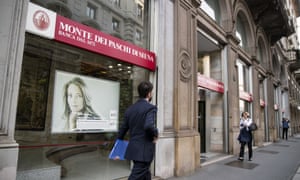
Italy plans Monte dei Paschi di Siena rescue if private bailout fails

State would inject billions of euros into struggling bank if capital-raising plan does not work, says finance ministry official

Italy is prepared to launch a multibillion-euro rescue of Monte dei Paschi di Siena (MPS) by the end of this week if the bank fails in its last-ditch effort to secure €5bn (£4.2bn) from private investors, according to a finance ministry official.

The official told the Guardian the ministry was “fully confident” that the world’s oldest bank would be able to carry through its plans to bolster its financial strength without recourse to the taxpayer.

“We are confident that the full plan works. So far we can only wait and see,” the official said. “We think MPS will be able to raise capital on the markets over the next few days.”

Shares in Italy’s third largest bank have seesawed in recent days amid uncertainty about how it will meet regulator’s demands to find more capital after it was the weakest performer of any of the 51 banks tested by the European Banking Authority in an annual health check of the sector in July.

MPS had asked the European Central Bank for an extension from the end of the year to 20 January to find the extra capital. The ECB is reported to have rejected such a move, which raised fears that the Italian government would have to intervene and on Friday drove its shares down 10%. But on Monday the shares were up 3.5% after MPS said it would press on with its existing plans to find funds. This includes a debt-for-equity swap and also a cash call to raise about €2bn from investors.

Fears about the strength of Italy’s banking system, which is weighed down by €360bn of bad loans, have focused on MPS. But UniCredit, Italy’s biggest bank, is expected to announce on Tuesday its intention to tap investors for about €13bn when its chief executive, Jean-Pierre Mustier, meets investors in London. Any cash call by UniCredit would take place early next year, by which time the European authorities will have hoped to plug the gap at MPS.

If MPS fails to secure a rescue by private investors in the coming days, Italy would embark on a precautionary recapitalisation, the finance ministry official said. Such a move would cost Italy between €2bn and €4bn and would fall under EU rules that forbid state intervention unless bondholders first take a hit.

The private sector plan is being led by Wall Street bank JP Morgan and is thought to require a major investor – such as the sovereign wealth fund from Qatar – to commit about €1bn. However, it is thought that an investment on that scale would not be made until the political uncertainty sparked by the resignation of the prime minister, Matteo Renzi, abates.

Paolo Gentiloni, the foreign minister in Renzi’s government and now prime minister-designate, is in the process of forming a new government – a move that could make it easier to attract investors to MPS. The private capital injection ought to be launched by the bank this week and any intervention by the Italian government – if it becomes necessary – would not take place before this Friday or next Monday.

While retail investors who hold €2.1bn of bonds in MPS might incur losses through a state intervention, Italy could probably seek an arrangement in which those bondholders would eventually be compensated. The prospects of tens of thousands of ordinary Italians losing their savings is one reason why such a rescue has been politically toxic even though MPS has long been considered the weakest bank in Italy.

The problems facing Italy’s banks are reflected in forecasts for the country’s economic growth. The ratings agency Standard & Poor’s forecast for growth in the eurozone’s third largest economy will fall below 1% over the next two years.

MPs to test rules aimed at insuring against UK bank bailouts

Treasury committee chair Andrew Tyrie says public has right to know how well protected they are from the fallout of any large bank failure

The banking sector is to face fresh scrutiny from MPs, who are embarking on a new inquiry to examine rules put in place after the financial crisis in 2008 to prevent further billion-pound taxpayer bailouts.

Andrew Tyrie, the Conservative MP who chairs the Treasury select committee, said the public had a right to know if they were protected from a repeat of the financial crisis, when £65bn was pumped into Royal Bank of Scotland and Lloyds Banking Group.

“The public was forced to foot the bill – and a large one – when the banks got into trouble during the crisis. They are still footing the bill now, with the profitable disposal of RBS looking like an ever more distant prospect,” said Tyrie.

Last month, RBS failed the Bank of England’s stress test – an annual health check of the sector introduced after the crisis – in a move exacerbating the problems facing Philip Hammond in reducing the taxpayer stake below 73%. The chancellor said in October that a sale of any more shares in RBS was not practical after his predecessor George Osborne sold off a 5% stake at a £1bn loss in August 2015.

As he launched a call for evidence by 5 March, Tyrie said: “Eight years on from the crisis, a great deal of effort has gone into ending ‘too big to fail’.”

Among regulator efforts to make banks safer were new rules to force them to hold more capital, to outline how they could be broken up in the event of collapse, and the ringfencing requirement devised by Sir John Vickers to protect high street operations from investment banking businesses.

The financial crisis showed that banks were not holding enough capital to cushion them against the risks they were running. When they needed more funds, it was taxpayers, not investors, who footed the bill.

“The public have a right to know whether they are now adequately protected,” said Tyrie. “Ringfencing and resolution regimes are intended to ensure that the failure of large banks can be managed in an orderly way, without relying on public support. It is vital to establish how robust they are.”

Tyrie also chaired the parliamentary commission on banking standards, which was instigated after the Libor-rigging scandal and looked at the way taxpayers stepped into rescue ailing banks. “As the parliamentary commission on banking standards concluded, the assumption that failing banks would receive public support was part of a toxic cocktail of misaligned incentives which contributed to the financial crisis,” he said.

The EU has also implemented rules that require bondholders to take losses in collapsing banks before taxpayers can pump in funds.

Among the questions posed by the Treasury select committee in its terms of reference, is the impact of Brexit, if any, on the UK’s regime for handling troubled banks and how far advanced are UK banks in meeting current rules. The Vickers rules, for instance, need to be implemented by the start of 2019.

The British Bankers’ Association backed the latest inquiry. “The UK taxpayer should never again have to foot the bill when a financial institution finds itself in difficulty. The BBA therefore welcomes the Treasury committee’s inquiry into capital and resolution and looks forward to contributing to it,” a spokesperson for the lobby group said.

HSBC shutting four bank branches a week

Consumer body Which? calculates that banks have closed 1,000 branches in past two years as online banking grows

HSBC has revealed that it is shutting more than four branches a week and that at least 57 more will be axed in the first few weeks of 2017. High-street banks have closed more than 1,000 branches in the UK during the past two years, according to consumer body Which?.

It has called on banks to consult with communities before implementing closures to ensure that the needs of their customers are being met. The organisation said its research had found that 1,046 bank branches were shut, or due to shut, between January 2015 and January 2017. It added that HSBC had axed the most branches over this period: a total of 321, representing a quarter of its network. HSBC told the Guardian it had closed 222 in 2016 alone, taking its current tally to 755.

The second largest number of closures, according to Which?, was at the Royal Bank of Scotland group, which has closed 191 outlets, followed by Lloyds Banking Group – which includes the Lloyds, Halifax and Bank of Scotland brands – with 180 branch closures, Barclays with 132, the Co-operative Bank (117, 53% of its entire network), Santander (87) and TSB (18).

The British Bankers’ Association reported earlier this year that the average high street bank branch dealt with only 71 customer visits a day - a 32% decline since 2011 - as consumers switched to online methods of managing money. However, the Campaign for Community Banking Services said it was concerned that branch closures were “proceeding at a faster pace than any alternatives that are being put in place to assist vulnerable customers”.

Which? said that 56% of adults used online banking last year, leaving about 20 million adults who did not use it. “Among them will be people who aren’t online and those with a poor broadband connection,” it said.

Guardian research has indicated that HSBC branches being axed in January 2017 include: Eccleshill in Bradford, Barnard Castle in County Durham, Moreton-in-Marsh in Gloucestershire, Lister Gate in Nottingham, Holbeach in Lincolnshire and Glossop in Derbyshire (all 6 January); Cowes and Shanklin, both on the Isle of Wight, Holmfirth in West Yorkshire, Rye in East Sussex and Cinderford in Gloucestershire (all 13 January); Malmesbury in Wiltshire and Whitchurch in Cardiff (20 January); and Shepton Mallet and Burnham-on-Sea, both in Somerset, Kingstanding in Birmingham and Nantwich in Cheshire (27 January).

Peter Vicary-Smith, the chief executive officer at Which?, said: “Banks can and must do a better job of working with their customers to understand their needs and those of the local community, especially when they are making changes to the services they offer or closing branches.”

HSBC said there had been huge changes since its UK branch network was established more than a century ago, with many people moving their banking online. Overall footfall in its branches had fallen by more than 40%, with 93% of contact with the bank now by phone or online and 97% of cash withdrawals made via an ATM.

“We do review our branch network to make sure they are in the right locations for our customers and we have a sustainable network for the future. When we do make the decision to close a branch, our main priority is to ensure that our customers and their banking needs are catered for in the best way possible.”

Hurrah, some of the world’s largest banks have been rounded up to underwrite a €13bn (£11bn) rights issue at the giant Italian lender UniCredit. This is unequivocally good short-term news for Italy and the European banking system since the alternative would have been an immediate crisis for both.

Yet, eight years after the global banking crash, Italian and European banking regulators should hang their heads in shame that a bank the size of UniCredit should require such a large infusion of fresh capital. This is UniCredit’s third fundraising since 2008, a damning statistic. Do it once and do it properly, says the old rule of refinancing. In Italy’s case, the authorities pretended that time would wash away a slug of the bad loans in the system. Instead, in a stagnant Italian economy, the rot spread.

A sum of €13bn does, at least, give UniCredit the chance to give its pipes a proper rinse. Provisions will be increased by €8.1bn and a €17.7bn portfolio of bad loans will be sold off. In parallel, around 14,000 jobs will be cut over three years in an attempt to make cost ratios vaguely competitive.

At the end of the process, sometime in 2019, UniCredit will emerge with a return on equity of 9%, says chief executive Jean-Pierre Mustier. That would be a big improvement on the current position but may imply that UniCredit won’t achieve returns greater than its cost of capital. That’s just modern reality, Mustier argues, correctly: the days of chasing 20% returns are over for all banks. The more important measure is capital strength and, if UniCredit can get to a core ratio of 12.5% in 2019, it will be back in land of the respectable.

The self-help plan seems bold enough to ensure that the fundraising will succeed in January without the need to call on the underwriters; there are only a few weeks to wait, and Italy won’t be holding any more referendums. But UniCredit’s drawn-out saga does not inspire bullish thoughts about Italy’s ability to tackle its many economic and financial woes within the eurozone.

A radical plan for the bank has emerged only after years of delay, and stragglers such as Monte dei Paschi di Siena still await their fate. Meanwhile, the restructurings – as opposed to the immediate fundraisings – will require work over many years to succeed. The backdrop is high unemployment, low growth and the rise of eurosceptic parties. Crisis over? Hardly.


Steve Rowe, the new M&S chief. Photograph: Toby Melville/Reuters

Unanswered questions at M&S

One of Robert Swannell’s contributions to Marks & Spencer is secure for all time. In 2004, as a supremely well-connected City investment banker, he led the advisory team that helped save M&S from Sir Philip Green’s attempted takeover. The nation gives thanks.

The Green episode, however, saddled all subsequent M&S chief executives and chairmen with a benchmark for success. Green’s offer, which never technically materialised (a bit like his promise to “sort” the BHS pensions deficit), was pitched at 400p-a-share, a price that is constantly watched inside and outside the company.

When Swannell became chairman of M&S in January 2011, the shares stood at 370p. On Tuesday, as he announced his departure next year, the price closed at 349p. Shareholders have had decent dividends on the way, of course, but in share price terms, M&S is roughly where it started. The buzz of excitement from the food side has been drowned out by the disappointments in clothing.

A chairman runs the board and not the company, so let’s not overstate Swannell’s role. But there is an unresolved mystery from his years. Under Marc Bolland, chief executive for most of Swannell’s time, M&S talked up its international prospects. Then Steve Rowe, who took over in April, said he would close 53 loss-making overseas stores in 10 countries, presenting the decision as an act of financial sanity given the size of the losses overseas.

Rowe’s logic seemed impeccable, so why didn’t the board curb Bolland’s enthusiasm? Swannell is staying until his successor is appointed, so there is still time for him to explain.


A sign for a Nissan car dealership. Photograph: Andrew Matthews/PA

Why keep the Nissan deal hush-hush?

Encouraging news: the UK did not incur an “identifiable contingent liability” when the government gave assurances to Nissan that the carmaker’s new investments in this country would not suffer after Brexit. So says Sir Amyas Morse, the head of the National Audit Office, in a letter to Andrew Tyrie, head of the Treasury select committee.

So why can’t we all see what Nissan was told in writing by Greg Clark, the business secretary, in October? Tyrie is right to keep pressing for publication. The government’s desire for secrecy looks increasingly ridiculous – and impossible to sustain.

Glass half-full: why self-serve beer isn’t the end for bar staff

The introduction of a contactless beer pump in a London bar doesn’t bode poorly for pub workers – as long as we don’t only drink ale in the future …

Name: Bar staff.

Age: Sorry?

Age! Oh, you know, between about 18 and 25.

Appearance: Adherence to what?

I said, APPEARANCE! Oh, right. Sorry, it’s a bit loud in here. Well, it depends on the bar. Most bar staff dress in an internationally popular style called “cooler than you are”.

Yeah, I’ve always thought that’s odd. I mean, I’m splashing my cash on a night out, they’re earning minimum wage in a low-skilled job, yet I’m the one who feels uncool. Well, fear not. Your days of relative uncoolness may be numbered, my friend.

Have I won a trendy makeover? People often say I would look better if my entire body was obscured by hair and tattoos. I’m sure you would, but no. You’re finally going to feel cooler than some bar staff because some of them are going to be machines.

Eh? The “world’s first” self-service beer pump with contactless card payments began trials this week at Henry’s Cafe & Bar in Piccadilly, central London. It has been designed as an attention-seeking gimmick by Barclaycard, which says it might launch it at festivals and other places where there are often long queues at the bar.

So now we’re letting computers control our beer? That’s right.

Actually, that’s probably quite wise. How does this thing work? Well, you select a drink on the screen, pay with your card, then place your glass under the spout and watch it fill with ale.

What if I don’t want ale? Tough. Lager is too fizzy to dispense reliably. Everything else is complicated in other ways. You get ale.

Will it refuse to serve me if I’m already drunk, as required by law? Oh, um, yeah. I’m sure Barclaycard has installed a pop-up breathalyser or something.

OK. And how does the machine know I’m older than 18? Apart from my dress sense, I mean. Dunno. You have to be 18 to have some bank cards. Or maybe a bored human has to stand next to the pump watching people use it, like at the supermarket.

And will they be cooler than I am? Almost certainly.

Do say: “I have read this ale’s terms and conditions. Cancel/Agree.”

Don’t say: “Are you barred? Yes/No.”

Banks may groan – but Andrew Tyrie is right to launch a new inquiry

The Treasury select committee should ask questions over banks’ capital, bailouts and our exposure from RBS

It’s been ages – actually only three years – since the last parliamentary inquiry into the banking industry, but here comes the tireless Andrew Tyrie with another. The Treasury select committee is to ask whether the revamped capital rules, supported by arrangements to wind down failing banks, are up to the job. Taxpayers are supposed to be protected in another 2008-style crisis. Would they be?

A collective groan, one suspects, will have passed across the banking sector at news of this inquiry. The so-called capital and resolution regime, after years of debate and fine-tuning, is supposed to be set in stone. The regulators perform stress tests on the big institutions every year; and the banks’ role is to get on with the job of reorganising their operations to fit the new ringfenced model while reordering their capital structures to contain the correct portion of instruments capable of absorbing losses.

Yet there are at least three reasons why Tyrie is right to have a prod. First, Sir John Vickers, one of the architects of ringfencing, is not convinced that the banks yet hold enough capital. The Bank of England disagrees, pointing out that the UK brigade has raised £130bn of new equity since the 2008, about twice the level of losses experience in the crisis. But that debate needs to be settled once and for all, preferably before the next crisis arrives.

Second, the current crisis in the Italian banking industry is a reminder that talk of state-funded bailouts has not been banished forever, at least in the eurozone. The Italian banks may, in the end, get all their capital from the private sector, but it is not reassuring that there is even room for doubt. UK taxpayers deserve to hear, in detail, how it could never happen again here.

Third, Royal Bank of Scotland is still 73% owned by taxpayers. To what degree is the state still on the hook should calamity strike?

The select committee, let’s hope, will be reassured. But this is the right moment to ask hard questions. Here’s one for Tyrie to add to his list: given that the ringfencing rules don’t come fully into force until 2019, how would the too-big-to-fail question be addressed before that date? Regulators tend to mutter and obfuscate when the question is put directly. Tyrie could do us all a favour by insisting on clarity.

Drax fired up after EU nod

It is only a slight exaggeration to say that Drax Group had bet the farm on winning EU state-aid approval to convert a third coal-burning unit to run on wood pellets. Without a thumbs-up, Drax would not have been able to afford its planned corporate reinvention via the £340m purchase of Opus Energy, a supply business serving small and medium-sized businesses. That deal, unveiled earlier this month, was conditional on Brussels coming good.

There was relief all round, then, that EU approval arrived, just as the long-serving chief executive, Dorothy Thompson, predicted. The handout may only be a last hurrah for biomass subsidies since the last UK government made clear its preference for offshore wind in the renewables stakes. But there’s nothing like the sight of guaranteed income – Drax will get £100 a megawatt hour at the converted unit – to lift an energy generator’s spirits. Drax’s shares rose 8% and have now improved by a quarter since the Opus announcement.

Justified? Yes, probably. A month ago, Drax, the UK’s largest power station, seemed destined to become an exercise in managed decline. Now “retooling for a post-coal future” – the clunky corporate slogan – may mean something tangible. Aside from coal and biomass, Drax will have a beefed-up supply business plus development sites to get into gas-fired stations one day.

It is an odd collection of assets that one probably wouldn’t design from scratch. But, yes, given Drax’s turbulent history, one can call it a sensible diversification of risk.

Apple’s rotten jibe at Vestager

The great EU versus Apple and Ireland tax battle will be fought on facts, in particular the right of Brussels’ competition commissioner to intervene in the tax affairs of an EU member state. The legal scrap will take years.

In the meantime, though, note Apple’s petulant line about why it thinks it found itself in the sights of Margrethe Vestager. The Danish EU commissioner wanted a target that “generates lots of headlines”, claims the US technology company. This is self-regarding nonsense. When the sum at stake is €13bn (£10.8bn) in allegedly unpaid taxes, Vestager would be failing in her job if she didn’t act.

Transitional deal would reduce Brexit's risks to financial stability – BoE

Bank of England deputy governor indicates details of arrangement needed within nine months of article 50 being triggered

A transitional arrangement for the UK’s departure from the EU would pose fewer risks to financial stability and cause less complexity for the City firms impacted by Brexit, a deputy governor of the Bank of England has said.

Speaking to the Treasury select committee, Sam Woods indicated details of that arrangement would be needed within nine months of article 50 being triggered. That formal process of leaving the EU is expected to be started in March.

Earlier this week,the chancellor, Philip Hammond, told the committee that the government would probably seek a transitional deal in order to avoid disruption that could risk financial stability.

Asked about this on Wednesday, Woods said: “I think it would reduce the risks. It seems to be just as true for the rest of the EU … as it is for the UK. It’s in the interests of all parties to have a reasonable implementation phase.

“It’s a question of the sooner the better. I wouldn’t want to be sat here in a year’s time a transition not having been agreed.”

He told MPs that the Bank of England was being kept informed of contingency arrangements being drawn up by City firms which were most likely to be badly affected by not being able to continue doing business in continental Europe in the same way as now. Firms could roll these out in a “small number of months”, said Woods.

A transitional agreement would be beneficial for the firms which might be affected, particularly what he described as trading banks and those operating in the wholesale markets.

“Without exception those firms who are affected directly would all like to see a transition period. The smoother the adjustment ... the lower are likely to be risks to financial stability and safety and soundness,” Woods told the committee.

He also referred to his time as part of the team which devised the banking reforms outlined by Sir John Vickers in 2011, and which require banks to ringfence their high street operations from their investment banks by 2019.

“The harder the border ... the more complex are likely to be the structures the firms adopt … that would be a step backwards. The more complex the firm the more difficult it is to manage, the more difficult it is to supervise and the more difficult it is to resolve,” said Woods.

Monte dei Paschi di Siena tries to keep €5bn rescue plan alive

Italy’s third largest bank seeks to avoid government bailout with debt-for-equity swap offer to retail investors

Executives at Monte dei Paschi di Siena (MPS) are fighting to salvage a multibillion-euro rescue by private investors in a frantic attempt to prop up the bank.

In a statement released after a board meeting on Sunday, the world’s oldest bank said it would forge ahead with a debt-for-equity swap offer for tens of thousands of retail investors. The offer still requires regulatory approval. If MPS manages to convince investors to go along with the plan, it would help it avoid a government bailout by Italy, which would have far-reaching economic and political consequences.

A deal to prop up MPS was thrown into doubt last week after the European Central Bank (ECB) reportedly said it could not have more time to secure the private investment. MPS had sought an extension until 20 January.

Markets are now waiting to hear the future of a planned €5bn (£4.2bn) cash injection by private investors to rescue the bank by 31 December.

Reports of the ECB’s decision, which were released on Friday and not publicly confirmed, have raised fears that MPS would not be able to secure the private funds in time and that it would therefore require a “precautionary recapitalisation” – or rescue – by Italy.

The fate of MPS is critical for a number of reasons. It is Italy’s third largest bank and a failure to secure the private funds would immediately raise doubts about the stability of a number of other Italian banks, such as UniCredit, which also need to raise private capital.

Any rescue of the institution by Italy under EU rules could lead to billions of euros in losses for retail investors, which in turn would damage the ruling Democratic party at a time when it has already been diminished by Matteo Renzi’s resignation as prime minister last week following his defeat in a referendum on constitutional reforms.

Under new EU rules, taxpayer funds cannot be used to rescue a bank unless bondholders take losses first.

Italy could probably get the green light from Brussels to compensate certain junior bondholders, lessening the damage to investors and the political fallout, but the details of any such agreement are far from clear.

Analysts said any such arrangement would involve refunding investors who fall below certain thresholds in terms of income and wealth.

Shares in MPS closed down 10% on Friday following reports of the ECB’s decision. The ECB refused to comment and gave no formal confirmation to MPS, but its decision may have closed the door to a private-sector solution under which major investors, including the sovereign wealth fund of Qatar, would invest €5bn in cash.

Federico Santi, an analyst at Eurasia Group, said that state support would likely be forthcoming if the private-sector solution failed to materialise.

Santi said any amount of “burden sharing” or losses inflicted on junior bondholders would be hugely unpopular and a serious blow to the government. He said that it might nevertheless be easier for an incoming government led by the prime minister-designate, Paolo Gentiloni, to take unpopular measures, since Renzi would still want to lead his party into elections. A new poll is expected to be called early next year.

Lorenzo Codogno, chief economist at LC Macro Advisors, said: “Now that the political situation is about to stabilise and a government will be in office on Tuesday, the solution for MPS could equally be in sight, but it is still not clear whether a private solution is still feasible or, more likely, some public money would be necessary.

Monte dei Paschi di Siena has already been bailed out twice in modern Italian history. Photograph: Mattia Sedda/EPA

“The problems of Italian banks will continue to drag on for months, if not years, but at least a framework would be in place to address the most pressing issues. It is now the final countdown.”

The country’s third-largest lender has already been bailed out twice in modern Italian history, but it became clear after Britain’s vote to exit the EU, which sent shockwaves across financial markets, that the Siena bank would require a third bailout.

The bank’s financial problems are nothing new. Italian banks have been weighed down by €360bn of non-performing loans that were mostly taken out by small Italian businesses which have been battered by years of recession. Italy returned to growth in 2015, but the improvements are only modest and the International Monetary Fund predicted that GDP would not likely return to pre-crisis levels until the mid-2020s.

MPS’s issues were exacerbated by other mistakes – principally a poorly judged €9bn acquisition – but its primary issue is that billions of euros in loans were extended by the bank at a time when the scale of the impending recession was being underestimated.

Lloyds snaps up MBNA for £1.9bn

Deal to buy credit card issuer with 7m clients and gross value of £7bn is bank’s first major acquisition since financial crisis

Lloyds Banking Group is to spend £1.9bn on MBNA, a credit card business owned by Bank of America, as the bailed-out lender continues its recovery from the financial crisis.

The UK bank’s first major acquisition since its £20bn rescue by the taxpayer during the 2008 crisis will give it a 26% share of the credit card market and allow it to produce £100m annual savings within two years.

Lloyds, 7% owned by the taxpayer, would not comment on the implications for the workforces of the two operations, which employ a combined 2,700 in Chester.

MBNA – one of the UK’s largest credit card issuers, with 7 million customers including its own brands and the official cards of several major football clubs – has been on the market for some time. Lloyds had been battling against US private equity group Cerberus, HSBC and Santander UK for the operation.

A firewall against claims for payment protection insurance (PPI) was thought to be crucial in securing the deal. The misselling scandal has already cost Lloyds £17bn – more than any other bank – and Lloyds said its exposure to MBNA’s bill was capped at £240m, indicating Bank of America will pick up the tab for anything above that threshold.

Lloyds Banking Group market shares Photograph: LLoyds Banking Group

The deal is expected to complete in the first six months of 2017, during which time the government is expected to sell the last of its shares in Lloyds.

Lloyds was the biggest riser on the FTSE 100 by mid-afternoon, up about 2.5% to 64p. The government is selling off its remaining stake at prices below the 76.3p average price at which taxpayers paid to take a 43% stake during the crisis.

António Horta-Osório, the Lloyds chief executive, said the MBNA name would be retained as part of the bank’s multi-brand strategy. Among its brands are Halifax, Bank of Scotland and car finance lender Black Horse. It also, he said, “advances our strategic aim to deliver sustainable growth as a UK-focused retail and commercial bank”.

Lloyds paid for the business out of its reserves, which sparked some concerns that it might not be able to pay a special dividend to shareholders. The bank insisted its payout policy was not altered. “Nothing has changed,” said George Culmer, Lloyds’ finance director.

The transaction further focuses Lloyds on the domestic market at time when the UK is preparing to exit the EU. Joseph Dickerson, a banking analyst at Jefferies, said the deal was “a very good use” of Lloyds’ excess capital and that the terms looked attractive.

Dickerson said that a special dividend “is now unlikely but the MBNA acquisition looks a better use of excess to us”.

The deal will increase Lloyds’ market share of credit cards from 15% to 26%, making it second only to Barclaycard in terms of size.

Culmer acknowledged the deal was subject to competition approval but he said a recent study had found the credit card market was “healthy and competitive”.

The bank has a 25% share of current accounts, 22% of retail deposits and 21% of mortgages.

The Guardian view on Donald Trump’s team: not the new normal

The Guardian view on Donald Trump’s team: not the new normal

The idea that Donald Trump might become a “normal” American president once he moved into the White House was always for the birds. The 2016 contest was an abnormal election won by an abnormal politician. It was an abnormal election because hackers linked to the Russian government worked to help Mr Trump’s cause; because the head of the FBI tossed a political hand grenade into the closing stages of the contest which helped Mr Trump’s cause; and because, since a US supreme court ruling in 2013, states that want to have exploited a power to impose voter ID rules that intentionally keep African Americans off the rolls. Oh, and 2.8 million more Americans voted for Hillary Clinton than Mr Trump. That’s hardly normal either.

Mr Trump was and remains an abnormal politician because he threatens changes that, with almost no exception, are genuinely destructive to American values and interests, not least to the interests of many of those white working-class voters who voted for him in the hope of change. He has now assembled a government team which, again almost without exception, testifies to this reality. These appointments confirm that he cannot be regarded as a president like any other. Perhaps, in five weeks’ time, when he actually succeeds Barack Obama in the Oval Office, he will start to do things that suggest otherwise. But that has not happened yet.

The first threat from the new appointments is that it is Team Corporate America. The new secretary of state, Rex Tillerson, is one of the biggest oil moguls on the planet, chief executive of ExxonMobil, friend of Vladimir Putin and the Middle Eastern petrolocracies. The new energy secretary, Rick Perry, is an oilman and a climate change sceptic. Scott Pruitt, the new head of the Environmental Protection Agency, a body he would like to see closed down, holds those prejudices even more strongly. This will be a pro-carbon, pro-drilling and anti-climate change administration like no other.

It is also political Christmas for the Wall Street bankers. The new Treasury secretary, Steven Mnuchin, is a former Goldman Sachs investment banker whose stated priority is to cut corporate taxation by more than half. He will join former Goldman banker and Breitbart chief Stephen Bannon, Mr Trump’s ultra-rightwing chief strategist, and the Goldman president, Gary Cohn, who will become, in effect, the new president’s chief economic adviser. Mr Trump may have railed against bankers, and Goldman in particular, during the campaign, but he has put them at the heart of his economic thinking.

The third fox in the governmental hen house is the military. Mr Trump said during the campaign that he knew “more than the generals” about the threat from Islamic State. But the generals will occupy key roles in his administration to such a degree that the head of Human Rights Watch has said there will be a whiff of “military junta” about it. With James Mattis at defence, the temperamental Islamophobe Michael Flynn as national security adviser, John Kelly in charge of the enormous homeland security bureaucracy and Mike Pompeo as the new CIA director, military men have seized some key jobs. Whether this heralds the politicisation of the military or the militarisation of politics will be a key question.

Mr Trump’s appointments also point unerringly towards the dismantling of federal government programmes in other crucial areas. Making Andrew Puzder labor secretary puts an opponent of raising the minimum wage in charge of it. Betsy DeVos at education will be a privatiser running public schools policy. Tom Price at health and human services is both an arch-critic of Mr Obama’s affordable care programme and a privatiser of the Medicare retirement care programme. Ben Carson at housing and urban development does not agree with government safety nets. Overall, the military will prosper at the expense of the poor. Guns not healthcare.

There is nothing normal about any of this; just as there is nothing normal about appointing Jeff Sessions, the Alabaman who has spent years in the Senate trying to roll back voting rights for African Americans, attorney general; and nothing normal about the expected appointment of an anti-choice justice to take the vacancy on the supreme court. In heavily tainted circumstances, America has elected a president who seems wholly unable to distinguish between private interest and public responsibility. As long as Mr Trump does so little to respect his own office, it is hard for others to respect him and it as they would normally.

Charles Boardman obituary

Charles Boardman obituary

Our friend Charles Boardman, who has died aged 89, was a bank manager, bibliophile and director of amateur dramatics in his home town of Edwalton, Nottinghamshire.

Charles was born in Warrington to Harry and Bertha Boardman. He attended Wade Deacon grammar school, Widnes, and gained a place to study medicine at the University of Liverpool, but left after the first year after failing some of the exams. He was called up for national service and became a sergeant instructor in the Royal Army Medical Corps, based in Aldershot.

In 1950 he joined the staff of the District Bank, which later became part of the National Westminster Bank. In 1951, he won the Charles Reeve memorial prize for English with the Institute of Bankers’ exams. Charles served at branches in St Helens, Manchester and London (city office and Oxford Street). He went to Cambridge for his first managership in 1968, then to West Bridgford, Nottingham, in 1976, and Arnold, Nottingham, in 1981. He retired in 1987.

Charles was a huge book-lover and made consistently thoughtful contributions to the Guardian’s readers’ books of the year. Last year he chose Kent Haruf’s Our Souls at Night as well as new books by Tessa Hadley and Robert Harris. Over the years he enthused about his favourites, including Lydia Davis, Helen Dunmore and Alice Munro.

He gave friends parcels of books regularly and generously. Each book was carefully chosen, and accompanied by a typed advice note. This could include encouragement to try a new author as well as requests for feedback.

He was an active member of the Anglican church, and served for many years, first as treasurer (when he was famed for his theatrical and very amusing presentations of the annual accounts), and then as churchwarden at the Church of the Holy Rood in Edwalton.

He also loved music, opera, and the theatre, as well as the Archers and Coronation Street – and his cairn terrier, Emily. He directed many ambitious amateur plays in Edwalton with remarkable success, and held vinyl evenings for friends, with music drawn from his huge collection of LPs.

Sheila Adam and John Mitchell

Lloyds Banking Group fails to meet 'fee-free' basic account guidelines

Group accused of unacceptable behaviour after Treasury finds accounts of 3.6 million customers do not meet agreed standards

Lloyds Banking Group is failing to meet “fee-free” guidelines for millions of its basic bank accounts, which are typically held by people on low incomes.

Data published by the Treasury showed more than 3.6 million of the group’s customers were at risk of running up bank charges because their accounts did not conform to a voluntary agreement reached between the government and the major high street banks in 2014. The agreement was designed to widen access to high street banks and help vulnerable customers.

Labour MP John Mann, a member of the Treasury select committee, said the Lloyds group, in which the taxpayer still has a near-8% stake, was guilty of unacceptable behaviour.

It is understood one of the accounts affected is the Halifax Easycash account, where a customer can be hit with up to three £10 “returned item fees”a day in cases in which there is not enough money in the account to make a payment but and the bank refuses to allow them to go into the red.

Basic bank accounts are aimed at those who do not have a bank account or are ineligible for a standard current account. But the Treasury said that in the past, some banks sought to cut the costs of providing these by charging fees when direct debits or standing orders bounced. These charges were in some cases “very high”, and some people were effectively “unbanked” after ending up saddled with significant overdrafts that left them unable to use their accounts , the Treasury added.

In December 2014 the government reached a voluntary agreement with nine banking groups – including all the major high street names – which required them to offer fee-free banking from 1 January this year.

The Treasury said there were now just under 8m basic bank accounts open in the UK, of which more than 4.1m met the 2014 agreement standards. However, that leaves more than 3.7m where customers are still not benefiting from completely fee-free banking. The vast majority of these are operated by the Lloyds group, which includes the Halifax and Bank of Scotland brands.

The remainder – estimated at just under 100,000 – are operated by the Royal Bank of Scotland group, which is 73% taxpayer-owned.

The Treasury indicated that banks had been encouraged to migrate customers on old basic bank accounts to ones that met the guidelines, but it said they were not “compelled” to do so.

Mann said of the findings relating to the Lloyds group: “This is simply not good enough, and it’s time Lloyds were held responsible for their actions. Over 3 million customers don’t have the cheapest account possible, and that means they are potentially exposed to hidden fees.”

He added: “The only way Lloyds will resolve this is if they are forced to act, and that’s why I am calling on the Treasury and the Financial Conduct Authority to fine them a percentage of their profits until this is resolved.”

All of the basic bank accounts at the other seven groups – Barclays, Clydesdale/Yorkshire, the Co-operative Bank, HSBC, Nationwide, Santander and TSB – are fully compliant.

The Treasury also revealed that the Lloyds group accounted for almost half of the basic bank account market.

Lloyds has indicated it wrote to existing basic bank account customers and gave them the option to move. But some backbook customers were not eligible for the new accounts.

A spokeswoman said: “We welcome HM Treasury’s data which shows that Lloyds Banking Group is opening 36% of the new basic bank accounts, demonstrating our commitment to support banking for all …We believe all banks have a responsibility to provide basic bank account facilities to customers who would be otherwise excluded, and today’s announcement highlights that the sector has a responsibility to do much more.”

UK MPs unite to push for greater transparency from tax havens

Cross-party group backs amendment to criminal finances bill making overseas territories introduce public registers

The UK’s overseas territories face renewed pressure to abandon corporate secrecy after 80 MPs joined forces to demand greater financial transparency from offshore havens.

The cross-party group is backing an amendment to the government’s criminal finances bill on Tuesday that would force Britain’s 14 overseas territories to introduce public registers revealing the true owners of locally registered companies.

The move is expected to face fierce opposition from the handful of the UK’s overseas territories – including the British Virgin Islands, Turks and Caicos Islands and Anguilla – that have become some of the world’s most active secrecy havens.

Earlier this year, the Panama Papers scandal laid bare how offshore corporate secrecy regularly attracts illicit money flows linked to terrorism, corruption, money laundering, tax evasion, drugs and fraud. Some estimates have suggested as much as $32tn (£26tn) of the world’s wealth has been hidden offshore.

The MPs’ proposal, which is being tabled on the last day before parliament breaks for Christmas, would effectively give all overseas territories until 2020 to introduce public registers.

Earlier this year, many overseas territories refused to buckle under intense pressure from then UK prime minister David Cameron, who called for them to introduce registers.

The MPs’ amendment is to be tabled by Labour’s Dame Margaret Hodge, former chair of parliament’s public accounts committee. It has won backing from a wide cross-party base of backbench MPs, including including Andrew Mitchell, the Conservative former international development secretary, and Nigel Dodds, the Democratic Unionist party’s Westminster leader.

About 80 MPs – among them Greens, Liberal Democrats, Plaid Cymru, SNP and SDLP politicians – are due to add their voice to the amendment proposal. If such levels of support hold, it is expected to put intense pressure on the home secretary, Amber Rudd, to add her backing.

Such a move could spark angry reactions from many overseas jurisdictions and could even provoke local politicians to call for a severing of ties with the UK. Many territories may question why the amendment does not extend to the UK’s crown dependencies, include as Jersey, Guernsey and the Isle of Man.

It is extremely rare for the UK to use its special powers – known as “order in council” edicts – to impose laws on overseas territories. “Of course political parties have shied away from using these powers. They can seem somewhat colonial,” said Hodge. “But I think there are overwhelming moral arguments at stake here.

“The Conservatives used them to outlaw capital punishment; Labour used them to get rid of laws against homosexuality. Now we are facing another big moral issue ... Over half of the corporate entities exposed by the Panama papers were registered in the BVI, a British overseas territory.

“The UK is at the centre of a global web of tax havens which are costing UK taxpayers and developing countries huge sums of money.”

There are at least seven Tories supporting the amendment, led by Mitchell, who is calling on Theresa May’s government not to let the momentum for reform, built up by Cameron, fade away. “I hope this amendment will help the UK government to persuade the overseas territories to adopt the same level of transparency as the UK,” he said. “This is so important for people in developing countries who are losing out due to tax dodging.”

Sally Copley, the head of campaigns for Oxfam, the anti-poverty charity, said a number of developing world charities were backing the move. “These tax transparency standards are essential to hold the overseas territories accountable for their policies’ impact on other countries – especially the poorest, which are hardest hit and have the most to lose from tax dodging,” she said.

Government's Lloyds share sale takes stake to below 7%

Taxpayers have now recovered more than £17.5bn of the £20.3bn injected into the bank during the 2008 financial crisis

The British government has cut its stake in Lloyds Banking Group to below 7%, raising the amount recovered to more than £17.5bn of the £20.3bn of taxpayers’ money used to bail out the bank during the financial crisis.

The sale of a further 1% of Lloyds shares on Tuesday reduced the government’s stake to 6.93%, from a peak of 43%.

Simon Kirby, the economic secretary to the Treasury, said: “Selling our shares in Lloyds Banking Group and making sure that we get back all the cash taxpayers injected into it during the financial crisis is a key government priority. So I am pleased that we have continued to reduce our stake in Lloyds.”

The chancellor, Philip Hammond, announced in October that he was abandoning his predecessor’s plans to sell the remainder of the Lloyds stake to members of the public at a discounted rate.

Since then, the Treasury has been selling its remaining shares on the stock market, reducing its stake in stages from 9.2% to 6.9%. The aim is to have sold all its shares within a year, with the proceeds being used to reduce national debt.

The current sales are taking place at a price lower than the 73.6p average price paid for the stake during the crisis, but Hammond has said he expects to recoup the full amount injected into the bank. Lloyds shares are trading at just above 61p.

A spokesperson for Lloyds said: “Today’s announcement shows the further progress made in returning Lloyds Banking Group to full private ownership and enabling the taxpayer to get their money back.

“This reflects the hard work undertaken over the last five years to transform the group into a simple, low-risk and customer-focused bank that is committed to helping Britain prosper.”

While the government is selling off its stake in Lloyds, it retains a 73% stake in Royal Bank of Scotland which it also bailed out during the financial crisis.

Hammond said in October that the time was not right to sell its stake in the Edinburgh-based bank, in which a 5% stake was sold in August 2015 at a £1bn loss.

ECB refuses to help Italy's crisis-hit Monte dei Paschi bank

Italian government may have to prop up world’s oldest bank as recapitalisation deal falters

Fears that the Italian government will have to prop up Monte dei Paschi di Siena (MPS) are mounting after the European Central Bank refused to give the world’s oldest bank more time to find major investors to back a €5bn (£4.2bn) cash injection.

Trading in the troubled bank’s shares was repeatedly halted on the Italian stock exchange on Friday. The MPS share price closed 10% lower as the bank’s board held a meeting that had already been scheduled before the reports that the ECB had rejected its calls for an extension to the deadline to bolster its financial position.

The ECB refused to comment and gave no formal confirmation to MPS but its decision may have closed the door to a private sector solution, under which major investors including the sovereign wealth fund of Qatar would pump billions into the bank.

But MPS said on Friday night that its board would next meet on Sunday night and that it was pressing on with its private sector solutions

Even so there were concerns that the Italian government would still have to embark on a “precautionary recapitalisation” of the bank and potentially impose losses on retail investors who hold €2.1bn of the bank’s bonds. Under new EU rules, taxpayer money cannot be used unless bondholders take losses first. A precautionary recapitalisation takes place before a bank becomes insolvent.

ECB officials had told Reuters they hoped the refusal to extend the deadline would pave the way for similar support for other Italian banks which are struggling with €360bn of bad loans.

It appeared to leave the Italian government with little option but to embark on a “precautionary recapitalisation” of the bank and potentially impose losses on retail investors who hold €2.1bn of the bank’s bonds. Under new EU rules, taxpayer money cannot be used unless bondholders take losses first. A precautionary recapitalisation takes place before a bank becomes insolvent. The bank has capital above regulatory minimums.

ECB officials told Reuters they hoped the move would pave the way for similar support for other Italian banks, which are struggling with €360bn of bad loans.

The long-running crisis appeared to be coming to a head just days after Wednesday’s resignation of Matteo Renzi, the centre-left prime minister, prompted by his defeat in a referendum on constitutional reforms last weekend.

The fresh political uncertainty may have put off private investors who were crucial to the reform plan put in place after MPS was named the worst performer in annual stress tests on 51 major lenders across the EU.

The Italian finance ministry said it would not provide detailed comment until MPS responded to the ECB decision and it still believed such a capital increase was an “option” and was “waiting to understand whether it can work or not”.

Pier Carlo Padoan, Italy’s finance minister and a possible contender to replace Renzi, held a meeting earlier on Friday with the bank’s chief executive, Marco Morelli, and leaders of the banking consortium that have been working on the capital infusion for MPS.

News of the ECB’s decision coincided with ongoing discussions between Italy’s president, Sergio Mattarella, and political leaders over the appointment of a new prime minister who could face the decision of whether to impose losses on MPS bondholders.

With the recapitalisation deal in doubt, and a possible government rescue on the cards, the task of leading the country through a potentially contentious period may fall to Padoan, Paolo Gentiloni, the foreign minister, or even Renzi himself. New elections could be called as early as the spring.

Amid the uncertainty, the price of MPS’s bonds plunged. Tomas Kinmonth, a fixed income strategist at ABN Amro, said: “The market is trying to second guess what the plan is. If it’s private sector, the bondholders are safe”.

Some bondholders had agreed to a debt-to-equity swap, which was part of the private sector solution, and it was not clear what their status would be if the deal no longer took place.

The Eurosceptic Five Star Movement, the second most popular party in Italy, said the government needed to step into the fray. “MPS can only be saved by state aid in order to avoid bail-in rules [that hurt] small savers, as happened a year ago,” the party’s MEPs said in a statement on founder Beppe Grillo’s blog. “This is not the time to fear the European Union and a possible infraction procedure. The consequences of a disordered bail-in would be disastrous to say the least, almost apocalyptic if one considers the size of MPS.”

They added that it was time to “slam our fists at the table in Brussels ... while not giving a damn about the deficit”.

The state of the banking sector will be crucial for any recovery in the Italian economy, which has an unemployment rate of 11% and where living standards have barely grown since the country became a founder member of the single currency 15 years ago.

Analysts at Deutsche Bank said: “We believe that Italy made a major mistake in letting the banking sector slide into the current fragile condition without intervening while other euro area peers acted.”

Thursday, December 8, 2016

HSBC has closed all the accounts of campaign group and won’t say why

Searchlight is a respected organisation and we can’t think of any reason for the bank’s arbitrary action

HSBC, which I have personally banked with since 1964, recently announced that it will close the four accounts we hold for the campaign organisation Searchlight following a “review”. In a follow-up email it insisted there is nothing we can do to change the decision and that it will not give us a reason.

Searchlight has campaigned against racism and fascism for 52 years, published a magazine since 1975, and is well respected. We are not aligned to any political party and are multi-faith. We currently work with the University of Northampton and recently launched a research arm, Searchlight Research Associates, with many distinguished patrons.

We have no overdraft facility – our income comes from occasional grants, donations and subscriptions and is paid in by cheque, standing order or bank transfer. We have hardly any international transactions. We can think of nothing in our use of the accounts that could possibly give rise to any concerns.

The only reason I can think of is that the fascist individuals and organisations that Searchlight combats have maliciously given false information to the bank for the sole purpose of getting our accounts closed, and the bank has accepted it without investigation. Obviously, this is very disruptive and we are applying for new accounts with another bank but we don’t know whether it will accept our application in view of HSBC’s action. Although HSBC is acting within its terms and conditions, its unilateral action is contrary to all principles of justice. GG, Ilford, Essex

There’s nothing you can do to change the decision, says HSBC – except write to the media. As soon as I contact the bank you receive a flurry of phone calls and then two senior officials beg a meeting. The upshot is that the four accounts are reinstated with no more of an explanation than when they were closed. Its press office will only comment opaquely: “HSBC aims to provide the highest standard of customer service … where this has not been met we endeavour to work closely with the customer to resolve any issue as soon as possible.”

Abrupt closure of bank accounts without explanation is becoming a worryingly frequent issue in my inbox as banks run scared of draconian US crackdowns on anyone deemed complicit in money laundering. HSBC narrowly avoided prosecution by the US Congress, so the chances are it is neurotically reacting to any account with political overtones or foreign transactions, be it owned by a suburban householder or a high-profile campaigning group.

You’re lucky. Very rarely in my experience do the banks capitulate and reverse their decisions, however mystifying.

If you need help email Anna Tims at your.problems@observer.co.uk or write to Your Problems, The Observer, Kings Place, 90 York Way, London N1 9GU. Include an address and phone number.

RBS fails Bank of England stress test

Taxpayer-backed bank unveils plan to bolster its capital by £2bn after faltering in annual health check of UK banking system

Royal Bank of Scotland was the biggest failure in the Bank of England’s annual health check of the UK banking system and has embarked on a new plan to bolster its financial strength by £2bn.

The Edinburgh-based bank, which is 73% owned by taxpayers, is to cut costs and reduce its exposure to risky assets after the results of the toughest tests yet on the banking system were published on Wednesday.

Two other banks, Barclays and Standard Chartered, also struggled in the so-called stress tests, which are based on hypothetical scenarios including house prices falling and the global economy contracting by 1.9%. Barclays already has a plan in place to bolster its financial position, while Standard Chartered said it has not needed to take any action.

As the Bank announced the results of its third annual stress tests it warned of a “challenging period of uncertainty around the domestic and global economic outlook”.

Its financial stability report, a half-yearly update on risks to the financial system, listed domestic risks which include the uncertainty created by the Brexit vote, the commercial property sector, high level of debts in UK households and the potential vulnerability of the economy to a reduction in foreign investors buying UK debt.

Mark Carney, the Bank governor, said Threadneedle Street was keeping an eye on debt. Households are “drawing down their savings and borrowing for the first time since the crisis”, he said. Lending to households increased by 4.1% in the year to September, close to the fastest rate since the 2008 crisis.

Global risks were described as “elevated”, with the Bank also warning that there could be an impact on global trade from Donald Trump’s election as US president. Chinese debt is high and the Bank also highlighted risks in some countries using the euro, including those caused by a referendum in Italy on Sunday.

The Bank also provided its promised update on the health of the residential mortgage market and is keeping in place measures announced in 2014 to restrict lenders’ ability to help customers needing to borrow four and half times their income.

Carney said these measures were remaining because of household indebtedness. “This will help ensure that underwriting standards don’t slip from responsible to reckless as they have during past periods of consumption-led growth,” said Carney.

Three other banks, Lloyds Banking Group, HSBC and the UK arm of Santander, as well as Nationwide, were subjected to the tests which were introduced after the 2008 crisis.

The Bank found that in aggregate, the entire banking system was strong enough to withstand the test, which is based on a five-year scenario in which £44bn of capital is wiped out in the first two years – five times the losses incurred during the depths of the financial crisis. Another test will run next year. Some of the banks tested this year would have used their bonds to help bolster their financial position.

Under this scenario, another £48bn of costs are incurred to pay fines and legal costs – more than the £40bn hit the banks took between 2011 and 2015. The risk of further penalties was one of the reasons RBS failed to meet the hurdle set by the Bank as it awaits a penalty from the US for mortgage bond mis-selling before the crisis. RBS shares initially fell 4% but ended the day 1.3% lower while shares in the other banks tested were higher.

Ewen Stevenson, RBS finance director, said: “We have taken further important steps in 2016 to enhance our capital strength, but we recognise that we have more to do to restore the bank’s stress resilience, including resolving outstanding legacy issues.”

Deeper cuts to costs are expected when RBS reports its results next year which could entail job cuts. Analysts at UBS said: “We expect a bigger cost and restructuring plan [from RBS] in February.”

Laith Khalaf, senior analyst at Hargreaves Lansdown, pointed out “RBS is in no immediate danger” although he said the bank was the “weak link in the UK banking chain”.

Barclays said it had passed the Bank’s test. Standard Chartered said it “has a strong and liquid balance sheet and the results of the stress test demonstrate its resilience to a severe global stress scenario”.

The European elite have developed a death wish

The European elite have developed a death wish

‘Good news for Europe,” read the first line of the analyst note. If I tell you it was from an investment bank that backed eurozone austerity to the hilt, you might guess what the good news is. Yes, François Fillon (the French Thatcher) stands poised for a runoff with Marine Le Pen (the French Mussolini) in next year’s presidential election.

What could be better news for the investment banking community than having all non-fascist voters, left, right and centre, obligated to vote for a politician who wants to slash the welfare state, sack workers and extend the working day?

Berenberg, the German private bank that issued the note, could not wait to celebrate Fillon’s success in the primary. “With luck,” its chief economist, Holger Schmieding, assured clients, “2017 could be more of an opportunity … than a risk.” The “opportunity” is for a Fillon government, with no credible socialist opposition, to enact “pro-growth” measures – attacking wages, hours and welfare, and enriching the people who hold €40bn in the private bank. It is symptomatic of the huge political miscalculation that the European political elite is making.

The European Commission president, Jean-Claude Juncker, told an Austrian newspaper on Sunday that there would be no letup on federalising Europe; no national opt-outs from the stagnation economics administered from Brussels.

Next Sunday, we get to see whether European centrism’s “double-or-quits” strategy will pay off. In Austria, where far-right populist Norbert Hofer is neck and neck with a Green candidate in the re-run of the election for the ceremonial presidency role, the left and centre are frantically trying to mobilise party-loyal working-class voters. They may fail.

In Italy, on the same day, the centre-left government looks set to lose a referendum designed to strengthen the power of the executive over parliament. If the prime minister, Matteo Renzi, steps down and the markets crash, and Europe imposes a bank rescue plan that raids ordinary people’s savings, then you could get both a domestic banking and a eurozone crisis by Christmas.

To complete the pattern of wilful idiocy the International Monetary Fund (IMF), according to Greek government sources, chose this week to press Greece for yet more public spending cuts – on pain, again, of the enforced collapse of its banking system. Oblivious to the neo-Nazi assaults on migrant camps in the Greek islands, the IMF in Washington – like the commission and the ECB – can only see rules and balance sheets.

It feels, in short, as if the European centrist elite has developed a death wish. And once you understand European culture this morbid possibility is not so far-fetched.

In his 1912 novel Death in Venice, Thomas Mann portrays the death-wish of cosmopolitan European culture through the love-obsession of a sick old man. The protagonist, Aschenbach, checks himself into a cosmopolitan hotel in plague-ridden Venice, to fulfil his wish to die. Writing two years before European cosmopolitanism did indeed die, Mann was already on top of the reasons why it might.

In the novel, city authorities deny the existence of the plague – and, in so doing, create the conditions for its spread. Often read simply as a parable about love and loss, the novel in fact deals explicitly with the self-destructiveness of what Mann called the “European soul”. Mann’s settings in this and other novels – the Lido hotel, the Swiss sanatorium – emphasise the fragility of a transnational culture once crisis breaks out.

For Mann, the carefully crafted polycultural world of the hotel lobby – where the Poles speak French, the Italians dress in Parisian fashion, and the band plays selections from Hungarian operetta – is a fragile illusion. When just one piece of it falls apart, everything does.

Today our polyculturality is not so fragile as in the belle epoque. The Schengen freedoms are, for white people at least, real. The Erasmus programme, the EU’s student-exchange project, cross-pollinated the lives of more than three million students. Alongside the staid and worthy “city of culture” programme, Europe’s young people have been creating the real thing: in the Berlin arts scene, in massive music festivals such as Benicàssim in Spain, in the wild nightlife of contemporary Belgrade.

But even this grassroots culture of globalisation is breakable, if you try hard enough – because it can only exist in a space sealed off from official politics. At the typical European bar, beach or coffee shop, tolerance exists because educated people leave their nationality and religion at the door. The assumption among the young – implicit but strong – is that all politics is bullshit and does not matter.

Now politics and nationality have begun hammering on the door. And initially they have produced mainly paralysis and fear.

When I asked the young people I met in Ferrara, in northern Italy, in September how they would respond to the new xenophobic wave, many spoke about “genuino clandestino” – a back-to-the-land movement that advocates disconnection with the official economy as a survival strategy against austerity.

“It’s over, it’s impossible, the right has won,” are responses you will hear everywhere among the young, once you stop speaking to activists and listen to small-town kids wasting away their 20s in their grandmother’s spare room.

So Fillon v Le Pen is not “good news for Europe”. Neither is Juncker’s promise to double down on all the mistakes that led us here; nor the IMF’s insistence that Greece should destroy its democracy some more; nor Renzi’s decision to play shit or bust with the Italian banking system.

This is no longer a confident, transnational elite, revelling in Samuel Huntingdon’s famous description of national governments as “residues from the past whose only useful function is to facilitate the elite’s global operations”. And they are now up against a far-right international movement – Trump, Farage, the Breitbart media folks – whose coherence waxes as the globalists’ coherence wanes.

We can stop this. But only if we reject the incessant demand for austerity, privatisation, longer hours, lower wages and the theft of a young generation’s future. That’s why the centre-left, in the short time available, must find the French people somebody better than Fillon.

Banks act to stop transfer scams and errors

‘Confirmation of payee’ system matches account number to holder’s name, so users will know cash is going to right recipient

Britain’s banks and building societies are promising a radical change to the way account holders send money to other people in a bid to tackle ballooning fraud and “fat finger” problems.

In future, the “confirmation of payee” system will mean that when someone types in a sort code and account number to transfer some money, they will receive an instant message saying something like “Is ‘Fred Bloggs’ the person/business you intended to send the money to?” Crucially, this will appear before the money leaves the person’s account.

Currently, customers only receive a confirmation that they have sent their money to a specific sort code and account number. Many people also type in the account name of the person they’re paying, but this is irrelevant as banks do not cross-check this element when processing payments.

The result is cases where individuals enter a wrong number on the eight-digit account number – dubbed a fat finger error – and the money goes to an unintended recipient. In some cases the mistake can be repeated for years – and the banks are not liable.

In one case covered by the Guardian, a hairdresser intended to send her monthly salary payment from HSBC to a joint Nationwide account with her husband, but initially entered a digit incorrectly. Over two years £26,000 of her pay went to another individual with a Nationwide account, and she has spent years fighting to recover it.

A new-style fraud, meanwhile, is seeing criminals hijack the emails of builders or solicitors. Customers are sent instructions to make future payments to a new account – still in the name of the builder or solicitor – with a new account number. In one case a couple were conned into sending £25,000 to the wrong account, and their bank refused any compensation.

According to the Payment Strategy Forum (PSF), which is handling the implementation for the banks and building societies, the “confirmation of payee” system should largely eliminate both problems. Account holders will still not have to enter the intended recipient’s name, but will continue to enter the sort code and account number as they do currently – crucially, however, they will then receive a message matching the sort code and account number with the specific account holder – such as “John Smith Builders”.

The exact implementation date and the precise message that account holders will be sent is yet to be determined, as the move requires a major systems change at banks to enable them to instantly identify recipients. The PSF says the latest date will be 2020, but it hopes the system could be in place for launch in 2018.

“The confirmation of payee system ... will allow people to avoid sending payments to the wrong account, either by accident or being tricked into doing so, by ensuring a confirmation of the recipient is sent to the payer before any funds leave their account,” said Ruth Evans, chair of the forum, which is also examining ways in which account holders can bar their regular direct debits from leaving their account when they are short of money.

Currently, if someone is close to their overdraft limit and, say, they have an unusually large mobile phone bill that month, it could push them into hefty charges when it is paid by the bank, or be bounced and leave the account holder with a possible unpaid transaction fee.

The forum’s proposal is for a “request to pay” system whereby the mobile phone company would have to send a message to the account holder, through the bank, that it is about to take payment. The account holder could then accept or decline the payment.

Evans said: Request to pay will allow customers to authorise a regular payment, such as a utility bill or gym membership, before the company withdraws the money from their account. This will be a huge boost to people on variable incomes who may struggle to settle their accounts at the same time each month.”

About £75tn in payments was processed through Britain’s banks and building societies last year, but it is estimated that about £755m was stolen.

In September, consumer body Which? lodged a “supercomplaint” with financial regulators demanding that UK banks do more to protect customers tricked into transferring money to fraudsters.

Which? said banks should “shoulder more responsibility” when someone is conned into transferring money, just as they reimburse customers who lose money due to scams involving debit and credit cards or fraudulent account activity.

Ireland’s central bank has reported a substantial increase in the number of inquiries from UK-based financial services companies to operate from Dublin in the wake of the Brexit referendum.

Applications for an Irish base can take up to a year and deputy governor Cyril Roux said on Thursday that several overtures had moved from preliminary inquiries to the pre-application or application phase.

“Since the UK referendum, there has been a material increase in the number of authorisation queries from UK-authorised entities,” he said.

Dublin is vying with other European cities, including Frankfurt and Paris, to lure banks and other London-based service companies concerned about the potential loss of financial passporting – the ability to operate across the continent – when the UK withdraws from Europe.

“We’re seeing applications throughout the whole spectrum. We have applications for new business, the licensing of firms who are not present here, but we also see very significant indications from regulated firms that are small today but want to be big tomorrow,” said Roux.

“We see the whole gamut of firms inquiring for establishing or growing in Ireland, it is Mifid (markets in financial instruments directive) firms, insurance companies, CSDs (central securities depositories), payments institutions.”

However he reiterated previous warnings by the central bank that financial services must have a substantive presence in Ireland and those seeking brass plate operations, without transferring substantial numbers of employees or operations, would not be licensed.

Financial regulation was tightened up in Ireland following the bailout by the International Monetary Fund in 2010 and the central bank will be obliged under EU law to regulate those licensed in the country.

“Outsourcing and insourcing are acceptable – up to a point. One may outsource activities, but one may not outsource responsibility. A firm may not outsource to the extent that it is effectively hollowing out its regulated activity,” said Roux.

While Dublin is positioning itself as the only other English-speaking country in the EU with a similar legal system to the UK, virtually all the big US banks who would lose passporting rights post-Brexit, including JP Morgan and Citi, are already licensed to operate in Ireland. Earlier this year Citi, which has 9,000 employees in the UK, said it could make a decision on relocation in the first quarter of 2017.

Dublin is already one of the world’s largest centres for operating investment funds and has a growing financial technology and insurance presence.

Ireland’s financial services minister told Reuters last week that some firms making applications would be waiting to see if there was any further clarity on the terms of Brexit before making any final decision to move.