Thursday, October 27, 2016

Lloyds hit by fresh £1bn PPI bill

Latest payout takes bank’s cost of payment protection insurance mis-selling scandal to £17bn

Lloyds Banking Group has taken another £1bn hit for payment protection insurance, in a move it hopes will cap its bill for the mis-selling scandal at £17bn.

The fallout has cost the industry has already reached £37bn and looks likely to rise further in the coming days when other high street banks could add to their existing provisions for mis-selling the insurance product.

George Culmer, Lloyds’ finance director, said the £1bn top-up should be the last “big” addition to the bank’s PPI bill and was driven by the decision by the Financial Conduct Authority to set a deadline of June 2019 – rather than spring 2018 – for claims.

PPI

Lloyds has incurred the largest single bill for the scandal as it also owns HBOS, which it took over during the 2008 banking crisis.

The charge for PPI was revealed as the bank reported its profits for the first nine of months of the year, which were 50% higher at £3.2bn despite the PPI charge. In the third quarter, however, profits were down 15% at £811m.

Listed among the charges taken by the bank was another provision of £150m for packaged accounts, where products such as travel insurance and roadside assistance policies are bundled up alongside current accounts.

The taxpayer still owns a 9% stake in Lloyds – down from 43% at the time of the financial crisis – and the slump in its shares has forced chancellor Philip Hammond to abandon a plan to sell shares to the public at the discount. Instead Hammond has signalled that the remaining shares will be sold to City investors on the stock market.

The shares were the biggest fallers in the FTSE 100, down about 2.5%, but regained their losses as analysts digested the implications for the bank returning cash to shareholders next year. The shares are still well below the 73.6p average price at which taxpayers bought them during the crisis.

António Horta-Osório, the chief executive, who in August apologised to staff for the hit to the bank’s reputation because of revelations about his private life, said the sale of the remaining stake would not be his cue to leave.

“I am very happy at Lloyds. I … like the team here and I like the strategy,” said Horta-Osório, who took the helm in 2011 and immediately began the process of PPI payouts. Lloyds started with a £3.2bn provision, which at the time was thought to have been enough to tackle the compensation payouts.

He said: “The hard work undertaken in the last five years to transform and simplify the business has allowed the UK government to sell most of its stake in the group, returning £17bn including dividends on its original £20bn investment. We welcome the recent decision to recommence the sale of its shares.”

Since the rescue of HBOS approximately 45,000 jobs have been axed, and Horta-Osório would not be drawn on any further cost-cutting programmes as he said 60% of transactions with the bank could be conducted digitally.

Lloyds is the first major bank to report its third quarter results, which cover the period since the Brexit vote, and Horta-Osório played down the impact on consumers, saying: “We don’t see any change in consumer trends.”But, he said, with small business customers “there has been some impact on businesses holding back on investment”.

The bank also said its pension scheme had turned from a £430m surplus deficit of £740m as as a result of the plunge in bond yields caused by the low interest rate environment. Culmer said there was no need for immediate action to cut the deficit.

Analysts were watching for signals about the size of dividends to shareholders. Gary Greenwood, at Shore Capital, said there was potential for payouts.

“The real highlight is a much stronger than expected capital generation, which means that management has reiterated its guidance for the group to deliver full-year pre-dividend capital generation equivalent to 1.6% of risk-weighted assets – around £3.6bn or 5p per share – for the year as a whole,” he said.

Horta-Osório also reiterated remarks he made shortly after the EU referendum, hinting that Hammond should announce more spending on infrastructure in next month’s autumn statement.

“We strongly believe the economy requires a fiscal stimulus in terms of infrastructure and housebuilding. Interest rates have never been so low,” the Lloyds boss said.

Why did NatWest issue a threat to Russia's RT news channel?

Although it’s impossible to understand why the bank has pledged to close the outlet’s accounts, claims about it being a press freedom matter appear wrong

What was NatWest bank thinking of when it sent a letter to the RT UK news channel saying it was preparing to close its accounts?

We don’t know because the bank, which is part of the Royal Bank of Scotland (RBS) group, has not offered any public explanation beyond a bland statement.

Although it said such decisions “are not taken lightly”, did it not realise the likely press freedom implications and the likelihood of it generating conspiracy theories? This is a Russian outfit after all (formerly known as Russia Today).

In such circumstances, the immediate reaction from RT was entirely predictable. Editor-in-chief Margarita Simonyan said: “It’s completely obvious that this is a political decision and a result of the wild pressure on RT in Europe and Britain”.

I am assured that the British government, overtly or covertly, had nothing to do with the bank’s letter, so I think Simonyan was wide of the mark.

But whatever lies behind the bank’s reasoning, the wording of the letter strikes me as clumsy, high-handed and tactless. If it had genuine concerns about RT UK’s accounts, then it would appear reasonable to write saying it was reviewing its banking arrangements. Then discussions could have taken place.

Instead, NatWest appeared to have decided the result of the “review” in advance by stating that RT’s accounts would be closed in December, that the decision was “final” and that it was “not prepared to enter into any discussion in relation to it.”

The Russian government may have overreacted by responding with a threat of its own, saying it will be forced to retaliate in kind.

That is par for the course. In its political culture, a partially state-owned bank - which is the case with RBS - would be highly unlikely to exercise autonomy.

It has therefore assumed that there is a sinister plot and a denial of press freedom. In reality, of course, RT’s existence is of little consequence to the UK government.

Its audience is small. Its output is largely uncontroversial (and monitored, doubtless, by Ofcom for fairness). So there is no reason to harass the channel.

With NatWest having stumbled into this diplomatic mess, some transparency would be welcome. Some may well believe that the bank is likely to have been concerned about risk management and compliance. But there is no evidence to suggest any such problem.

RT UK, given its ultimate Moscow ownership, is not an ordinary customer, and it appears that the bank has unnecessarily, if naively, stumbled into, and thereby, stoked up, an international row.

However, there should be no illusion: there are no press freedom implications.

City banks plan to hoard bitcoins to help them pay cyber ransoms

City banks plan to hoard bitcoins to help them pay cyber ransoms

Several of London’s largest banks are looking to stockpile bitcoins in order to pay off cyber criminals who threaten to bring down their critical IT systems.

The virtual currency, which is highly prized by criminal networks because it is difficult to trace, is being acquired by blue chip companies in order to pay ransoms, according to a leading IT expert.

On Friday, hackers attacked the websites of a number of leading online companies including Twitter, Spotify and Reddit. They used a special code to harness the power of hundreds of thousands of internet-connected home devices, such as CCTV cameras and printers, to launch “distributed denial of service” (DDoS) attacks through a US company called Dyn, which provides directory services to online companies. DDoS attacks involve inundating computer servers with so much data traffic that they cannot cope.

There is no evidence that Dyn was the subject of extortion demands but it has become apparent that hackers have been using the code to threaten other businesses into paying them with bitcoins or risk becoming the target of similar attacks.

Twitter was among a those giant internet companies targeted by last week’s attack in the United States Photograph: Kacper Pempel/Reuters

Dr Simon Moores, a former technology ambassador for the UK government and chair of the annual international e-Crime Congress, the global body that brings together IT professionals, said the scale and ferocity of the attacks meant some banks were coming round to the view that it was cheaper to pay off the criminals than risk an attack.

“The police will concede that they don’t have the resources available to deal with this because of the significant growth in the number of attacks,” Moores said. “From a purely pragmatic perspective, financial institutions are now exploring the need to maintain stocks of bitcoin in the unfortunate event that they themselves become the target of a high-intensity attack, when law enforcement perhaps might not be able to assist them at the speed with which they need to put themselves back in business.”

Moores declined to identify the banks buying up bitcoins but it is understood senior police officers have been made aware of the practice. The cost to businesses of an attack can far outweigh paying off the blackmailers: telecoms provider TalkTalk lost 101,000 customers and suffered costs of £60m as a result of a cyber attack last year.

“Big companies are now starting to worry that an attack is no longer an information security issue, it’s a board and shareholder and customer confidence issue,” Moores said. “What we are seeing is the weaponisation of these [hacking] tools. It becomes a much broader issue than businesses ever anticipated.”

In recent months, DDoS attacks have led to around 600 gigabits of data a second being directed at targets – more than enough, according to experts, to bring most websites down.

Moores predicted that the situation was becoming critical. “Once it goes above a terabit, that wipes out any protection. No current protection systems can deal with that sort of flood.”

In September the website KrebsOnSecurity.com was the target of what it describes as “an extremely large and unusual distributed denial-of-service (DDoS) attack designed to knock the site offline”. Initial reports put it at approximately 665 gigabits of traffic a second, far more than is typically needed to knock most sites offline.

Some experts believe the attacks were launched in response to articles that Krebs had published about the DDoS-for-hire service vDOS, which coincided with the arrests of two young men identified as its founders.

The attack on Krebs was launched by a large botnet, a collection of enslaved computers – in this case, hundreds of thousands of hacked devices that constitute the internet of things (IoT), notably routers, IP cameras and digital video recorders. These devices are the internet’s achilles heel. Unlike personal computers or smartphones, they are often not password protected, relying on factory settings. Because of this they make soft targets for botnets scanning the internet for IoT systems that can be easily compromised.

The Krebs attack might have gone largely unnoticed outside of internet security circles if someone using the name Anna-senpai had not then chosen to release the source code that powered the botnet on to a hackers’ forum.

“When I first go in DDoS industry, I wasn’t planning on staying in it long,” Anna-senpai said on the Hack Forums site. “I made my money, there’s lots of eyes looking at IoT now, so it’s time to GTFO.”

Within hours of Anna-senpai’s decision to release the botnet into the wild, it was creating havoc as others started to employ the code to enslave more devices. Soon an army of zombified devices was mobilising against Dyn.

By targeting Dyn, it appears that hackers were able temporarily to disrupt a raft of sites. Others that reported problems included Mashable, CNN, the New York Times, the Wall Street Journal and Yelp.

Amazon’s web services division reported issues in western Europe. In the UK, Twitter and several news sites could not be accessed by some users.

Anna-senpai’s identity and motivation for releasing the code remains a mystery. Some believe state agents were involved. China, Russia and North Korea have all been mentioned in IT circles.

“While this particular attack [on Dyn] may not have been motivated by extortion, a new model of ransom-based attacks could be on the horizon, motivated to pay off threats for fear of infrastructure-wide customer outages,” said Thomas Pore, director of IT at Plixer, a malware incident response company. “An infrastructure outage, such as DNS [denial of service], against a service provider impacting both the provider and customers may prompt a quick ransom payoff to avoid unwanted customer attrition or larger financial impact.”

The headquarters in New Hampshire of US internet service company Dyn, which was targeted by hackers Photograph: Jim Cole/AP

The problem facing businesses battling the hackers is becoming one of scale. The devices the hackers can recruit to launch their attacks is growing exponentially.

It is estimated that there are anywhere between 7bn and 19bn devices connected to the IoT at the moment. Conservative predictions suggest that this figure will balloon to between 30bn and 50bn within five years.

At some point, Moores believes that the dam will burst as the rollout of connected smart devices will allow for the harnessing of devastating computer power that can no longer be repelled by existing IT security systems.

He draws an analogy with financial crises, predicting that a “Lehman Brothers moment” is on the cards.

“We’ve got to come to grips with this,” Moores said. “Everybody’s overexposed.”

RISE OF THE HACKER

The evolution of DDoS attacks

February 2000

“Mafiaboy”, a 15-year-old Canadian called Michael Calce, launches the first big distributed denial-of-service attack (DDoS), crippling popular websites. His Project Rivolta takes down Yahoo, the number one search engine at the time, and many leading tech companies.

January 2008

Hacking collective Anonymous targets the Church of Scientology in an operation called Project Chanology that briefly knocks Scientology.org offline.

April 2012

A cyber-attack by anti-Israel groups on the eve of Holocaust Remembrance Day fails in its attempt to erase all mentions of Israel from the internet.

March 2013

Spamhaus, a filtering service to weed out spam emails, is subjected to a DDoS attack after adding a web hosting company called Cyberbunker to its blacklisted sites. Cyberbunker and other hosting companies hire hackers to shut down Spamhaus using botnets. At its peak the attack was being conducted at a rate of 330 gigabits a second, around five times the average DDoS attack.

January 2016

A group called New World Hacking attacks the BBC’s website at a rate of 602 gigabits a second, almost twice the size of the previous record of 334 gigabits a second.

Deutsche Bank lights up to settle its investors’ nerves

Deutsche Bank lights up to settle its investors’ nerves

At times of great stress, bankers tend to reach for the ciggies – and that’s precisely what the highly embattled Deutsche Bank seems to have done.

The German group was revealed as a lead financial adviser on British American Tobacco’s planned $47bn takeover of Reynolds American last week – its biggest deal of the year and a useful smokescreen just before the bank’s results statement on Thursday.

Still, those results will be dominated by one major question – the financial health or otherwise of the bank – following the US Justice Department’s request that Deutsche pony up $14bn to settle all the beastly things it did with mortgage-backed securities.

That demand caused quite a lot of gasping in Frankfurt, meaning boss John Cryan has been attempting to calm investors’ nerves with claims he expects to settle on a smaller figure.

All of which might depend on Deutsche’s ability to charm Americans, which brings us to a second worry.

The US makes up around 25% of Deutsche’s revenues, according to Macquarie, and last week Wall Street banks announced results that were surprisingly good across the board.

Did the US banks take advantage of their German rival’s woes and poach all its business? Or might Deutsche have also benefited from an industry-wide stimulant that has resulted in a general high? By Thursday we should know.

Debenhams discounts

When Sergio Bucher was unveiled as the new Debenhams chief exec in May, it’s reasonable to assume he believed he’d signed up to a different job.

In that carefree time before the Brexit vote, the UK might have felt like a welcoming place for a Swiss-Spaniard to relocate to, and the referendum has made life even more tricky for the boss of the already embattled department store.

Pressure on the pound in the aftermath of the vote has hurt Debenhams’ share price as – like many clothing retailers – it often buys in dollars and sells in pounds.

Meanwhile, as Bucher prepares for what should be a routine City debut at the group’s results this week, investors have also begun fretting about the health of the retailer’s pension scheme.

Morgan Stanley analyst Geoff Ruddell warned last week: “Recent movements in bond yields lead us to believe that the scheme’s liabilities may have increased by more than £300m over the past 12 months and that, as a result, the company may disclose a net pension deficit of more than £200m.”

That missive came on the day Bucher started work – and thumped the shares. Welcome to Blighty.

Theatre of the absurd at William Hill

William Hill chairman Gareth Davis has never publicly said that enjoys the work of Samuel Beckett, but there is a touch of Waiting for Godot about the bookmaker at present.

The firm’s management is biding its time in anticipation of something big happening, and following the recent collapse of a pair of mergers, the parallels grow stronger: it was once said of Beckett’s two-act play that “nothing happens – twice”.

The problem with this inactivity is fairly obvious. Its rivals have not been sitting around (Ladbrokes and Coral have merged, as have Betfair and Paddy Power) while the uncertainties over a William Hill deal have spooked three candidates for the vacant chief exec role. The search for a new boss continues this week, but it’s not a total long shot that we’ll be watching a year-long performance of waiting for a CEO.

In fact, the bookmaker hasn’t managed to appointed a chief exec it actually wanted to hire since David Harding 16 years ago. When Harding left, Hills spent a year looking for his replacement, despite eventual successor, Ralph Topping, being a company lifer. Topping’s retirement was delayed by a couple of expensive moves to keep him in post, despite his replacement James Henderson joining the firm in 1985. Developing. Slowly.

After eight hard years and a £52bn loss, can RBS ever be privatised?

After eight hard years and a £52bn loss, can RBS ever be privatised?

Royal Bank of Scotland has racked up £52bn of losses since it was bailed out eight years ago this month: and when it reports third-quarter results on Friday it is expected to dive even deeper into the red.

The bank’s list of woes seem neverending, ranging from a potential £9bn penalty from the US authorities for mis-selling mortgage bonds a decade ago to allegations of bad treatment of small business customers. Its share price is so far below the 502p average price at which taxpayers pumped £45bn into the bank that the chancellor, Philip Hammond, has abandoned any attempts to sell off any more shares.

RBS’s troubles have prompted one thinktank to argue that it is time for a radical strategy rethink, after the bank scaled itself down from a global business with operations in more than 50 countries to one with a flag in just 13 and a renewed focus on the UK high street.

“It’s time for the UK government to put all options for the bank’s future back on the table and urgently examine whether there are alternatives that could deliver better value for taxpayers and the economy,” Laurie Macfarlane, an economist at the New Economics Foundation (NEF), argues in a paper published this weekend.

The vote for Brexit has given the NEF fresh impetus in its call for RBS to be broken up into 130 regional UK banks. Macfarlane argues that RBS could turn its focus to “lending for investment in production services such as manufacturing, retailing and distribution, telecoms, construction and energy”, which are spread across the UK.

“Turning it into a network of local banks could therefore help boost real-economy lending while investing in communities that have been left behind by our London-centric economic model – exactly the kinds of communities who voted to leave the EU,” he says.

It is not the first time that the NEF – among others – have called for a rethink of the strategy for RBS. Sir Vince Cable called for the dismantling of the Edinburgh-based bank when he was the business secretary in the coalition government. “At the very beginning of our government, we should have gone for the breakup option,” the former Liberal Democrat MP says.

“They should be trying to create sensible smaller banks out of the greater whole,” Cable adds. However, he acknowledges he has been told that the cost of breakup would be too high – illustrated by the problems RBS has experienced in trying to spin off just 300 branches, as stipulated by the EU as punishment for receiving state aid.

The difficulty RBS has encountered in selling off these branches, intended to be rebranded Williams & Glyn, was referred to by Hammond when he announced that ambitions to sell off the remaining 73% stake had been put on the back burner. “It’s clear that the disposal of RBS shares at a price that recovers taxpayers’ investment is not practical at the moment,” Hammond said. The shares closed on Friday at 190p.

Hammond’s predecessor, George Osborne, had indicated that selling the government’s stake at a profit was not a priority. He sold 5% at 330p a share – and a £1bn loss – in August 2015.

Ross McEwan, RBS’s chief executive, would be unlikely to welcome a radical review of strategy for the bank. Photograph: Peter Macdiarmid/Getty Images

Analysts hold out little expectation that the RBS share price will ever get back to 502p. According to Bloomberg, the average forecast by analysts is 180p a share – and thus, Macfarlane argues, it is time for a rethink: “It is becoming increasingly clear that there is no way the taxpayer can make its money back by selling RBS back to the private sector.”

The Treasury, though, is unlikely to have much appetite to embark upon a strategy reversal. Osborne commissioned a review into whether RBS should be split up in 2013. It backed off radical action and instead focused on putting £38bn of troublesome assets into an internal bad bank.

Ross McEwan, now entering his fourth year as chief executive of RBS, would be unlikely to welcome a full-blown review either. He has embarked on an effort to put a fresh focus on NatWest – the now-revived brand name for RBS’s high street banking business in England and Wales – through a new advertising campaign launched last month, and has turned the focus on the remaining businesses, which generate £1bn of profit a quarter. His problem, though, is that those profits are being wiped out by tackling the so-called “conduct issues” of the past.

Ian Gordon, banks analyst at Investec, also points out that RBS is the fastest-growing among its UK peers in terms of lending for mortgages and business. “But that is being drowned out by the bigger, more volatile, ‘known unknowns’,” says Gordon.

RBS’s problems

■ A settlement, yet to be negotiated, with the US Department of Justice over the way mortgage bonds were packaged up a decade ago and sold on to consumers. RBS has not been able to estimate the financial impact of this settlement but analysts put figures on it ranging from £4bn to £9bn.

The sale of 300 branches, to be branded Williams & Glyn, stipulated by the EU as punishment for the £45bn taxpayer bailout. The bank admitted in August that there was no longer any prospect of spinning this business out onto the stock market and is looking for a trade buyer. However, the obvious bidder, the UK arm of Spanish bank Santander, is said to have pulled out.

■ A much-delayed report into the treatment of small business customers. The investigation, commissioned by the Financial Conduct Authority, began after allegations first surfaced in 2013 that the bailed-out bank was deliberately wrecking small businesses to make profits.

Deutsche Bank swings to profit despite anxiety over mis-selling scandal

German lender surprises analysts with third-quarter gains as it dismisses claims it has called on government for help

Deutsche Bank surprised investors by reporting a profit for the third quarter of the year, as its chief executive admitted the huge settlement it faces from American authorities for a decade-old mis-selling scandal was having “an unsettling effect”.

Germany’s biggest bank has been rocked by reports that the US Department of Justice might demand as much as $14bn to settle the long-running dispute over the way it sold residential mortgage backed securities before the 2008 banking crisis.

Announcing profits of €619m, the chief executive, John Cryan, said: “The results for the quarter demonstrate well the strengths of our operating businesses and the outstanding work of our people. We continued to make good progress on restructuring the bank.

“However, in the past several weeks these positive developments were overshadowed by the attention around our negotiations concerning the residential mortgage backed securities matter in the United States. This had an unsettling effect. The bank is working hard on achieving a resolution of this issue as soon as possible.”

He warned staff in a memo that “the situation will remain tough for some time to come”.

Revenues were depressed and there were some outflows, the bank acknowledged, as a result of anxiety about its ability to pay the penalty. The bank’s liquid assets – ones it can use quickly to pay demands for cash – fell €23bn to €200bn between the end of June and the end of September. But Marcus Schenck, the finance director, said this had now stabilised.

Cryan has made clear that Deutsche – which employs around 8,000 people in the UK – does not expect the final bill to be as high as $14bn and has dismissed reports that the bank has called on the German government for help.

Deutsche’s shares plunged last month to levels they last traded at in the 1980s, slipping through €10, and the bank acknowledged that the anxiety about the DoJ settlement had knocked its business. On Thursday its shares were trading at around €13. A year ago they were at €27.

Cryan told analysts that reaching a deal with the DoJ and handling other litigation was his “top priority” but the timing is not under his control.

He admitted the ongoing talks were creating uncertainty: “Uncertainty that affects the market’s view of Deutsche Bank as an investment, uncertainty that affected some clients’ view of Deutsche Bank as a counterparty and uncertainty that even affects our financial planning and strategy execution.”

Cryan, a Briton who has been at the helm of Germany’s biggest bank since last year, said he was personally spending time with clients and attempting to “dispel some of the more lurid myths” about the bank.

“We know that when our name is in the headlines for the wrong reasons, our phone doesn’t ring as frequently,” said Cryan, who dismissed suggestions that investors were questioning his strategy for the bank.

The sale of Postbank – Deutsche’s high street operation – would not be rushed, he said, until an attractive offer was received. Cryan said he wanted to keep the asset management arm, which is currently being reviewed and is often regarded as a possible business for Deutsche to sell, as an integral part of the group.

The profits were a dramatic improvement on the same period last year when Deutsche made a €6bn loss. For the nine-month period, a loss of €3bn has been reversed to a €1.6bn profit.

Schenck said a decision had not been made on how bonuses would be paid to staff, but indicated that less would be paid out in cash and more in shares. “In what form variable compensation will be paid is not yet decided. Given the situation of the bank and the profitability situation … having more tied towards the share price development in the future seems to make sense,” said Schenck.

RBS paid consortium including Church of England at least £180m for flotation

Companies House documents show sums paid to church and private-equity firms that financed ill-fated spinout of 300 branches

A consortium made up of private-equity firms and the Church of England has received at least £180m from Royal Bank of Scotland for backing the bailed-out bank’s aborted attempt to float off 300 branches on the stock market.

The Edinburgh-based bank, 73% owned by the taxpayer, has already admitted that the ill-fated attempt to carve out the 300 branches under the Williams & Glyn (W&G) brand has cost £1.5bn.

Documents filed at Companies House shed light on the sums paid by RBS to the consortium – which, as well as the Church of England, included Corsair Capital and Centerbridge – formed three years ago to participate in the flotation of W&G. In a complex deal, they put £600m into RBS through a bond, which was intended to be exchanged for shares when the new bank floated on the stock exchange.

RBS may reveal further costs associated with the troubled branch spinout when it publishes its third-quarter results on Friday, at the end of a week in which rival bailed-out bank Lloyds Banking Group also reports, along with Barclays.

The sale of the 300 branches was forced upon RBS by the EU as a penalty for its £45bn taxpayer bailout in 2008. It has run into repeated problems and must now be completed by the end of next year. Ross McEwan, the RBS chief executive, warned last month that RBS faces unchartered territory if he cannot find a solution.

An attempt to sell the branches to Santander collapsed in 2012 and the deal with the consortium clinched the following year. But any attempt at stock market flotation was abandoned in August and the bank is now looking for a buyer.

The consortium was to have ended up with a stake of between 30% and 49% when W&G floated and the £600m bond converted into shares. The consortium used £330m of its own money to pay for the bonds and borrowed £270m off RBS.

Documents at Companies House for Lunar Investors – a limited-liability partnership set up by members of the consortium – show that in the period 26 September 2013 to end-December 2015 RBS paid £184m in interest to the holders of the bond. The consortium was charged £18m in interest for its £270m loan.

RBS said at the time the transaction was announced in September 2013 that it would pay the consortium a rate of interest between 8% and 14% a year. The documents at Companies House indicate that RBS was paying the higher rate of interest to the investors. It paid £100m for the 15-month period to end of December 2014 and £84m for the 2015 calendar year.

RBS would not comment on the payments, nor would Corsair. The Church Commissioners, which manages £7bn of the Church of England’s investments and helps funds dioceses and parishes and helps pay the pensions for clergy, said it had invested in W&G “due to our belief in the importance of competition in the banking sector and the vital role of challenger banks.

“We are pleased to have been able to work with Williams & Glyn on ethics in banking and are grateful to the management team for their enthusiasm on this issue,” the Church Commissioners said. It is reported to have a 10% stake in the consortium.

There had been hopes that W&G would be a new high-street competitor to the big four – RBS, Lloyds, Barclays and HSBC – along with TSB, which was spun out of Lloyds under instructions from the EU because of its taxpayer bailout. TSB is now owned by Sabadell of Spain.

Wells Fargo under criminal investigation in California over sales practices scandal

State’s attorney general is looking into whether employees committed identity theft by creating accounts without customers’ approval to meet sales goals

California’s attorney general is conducting a criminal investigation into whether employees at San Francisco-based Wells Fargo bank committed identity theft in the sales practices scandal that has rocked the bank, documents released on Wednesday show.

A search warrant and supporting affidavit released by the California department of justice show that agents sought evidence related to allegations that bank employees created up to 2m bank and credit card accounts without customers’ approval in order to meet sales goals.

The warrant, first reported by the Los Angeles Times, was served on 5 October as the attorney general, Kamala Harris, runs for the US Senate in next month’s election.

Copies obtained by the Associated Press under a public records request show her office sought the names of customers who had accounts opened without their permission, the names of employees who opened the accounts and their managers, and fees associated with the improperly opened accounts.

“We can’t comment on an ongoing investigation,” Kristin Ford, a spokeswoman for the attorney general, said in an email.

A Wells Fargo spokesman, Mark Folk, said in an email that the bank is cooperating in providing the requested information.

Justice department special agent supervisor James Hirt said in a 14-page affidavit seeking the search warrant that “there is probable cause to believe that employees of Wells Fargo Bank unlawfully accessed the bank’s computer system to obtain the PII [personal identity information] of customers”.

“The bank’s employees then used the unlawfully obtained customers’ PII to commit false impersonation and identity theft by opening unauthorized accounts, credit cards and various other products that resulted in the accumulation of fees and charges for Wells Fargo,” Hirt said.

Theresa May's private Brexit warning speech to Goldman Sachs – audio

Theresa May's private Brexit warning speech to Goldman Sachs – audio

Friday, October 21, 2016

How to Start a Photography Business

How to Start a Photography Business

Starting your own photography business is a great way to add a second income or a main income, if you work hard. While the photography market is competitive, many photography business owners have been able to find their niche and build a sustainable career. Like most creative endeavors, you need to balance your passion for photography with real business skills in order to be successful.

To build and grow your business, you need both raw talent and a knack for marketing. One photographer we spoke with said an ability "to market yourself" was one of the most important factors in success. You should continually be working to improve your craft and evolving your product, and work consistently on your own branding, online marketing and people skills. Without the two, the results will likely just be an expensive hobby rather than a viable full-time business.

In this article…

1. Startup costs
2. Your branding and reputation
3. Pricing
4. Customer expectations and contracts
5. Where to find work
6. More resources

Startup costs

Quality photography equipment is notoriously expensive, so you'll want to start off with the minimum: Buying a $5,000 lens doesn't make sense if your business isn't making money yet. Many professional photographers say to plan on budgeting about $10,000 to start your photography business.

According to professional photographer Austen Diamond, "building slow and smart" will help you stay nimble. Allow the organic growth of your business to fund gear improvements, and avoid debt if possible, he said.

Based on interviews with professional photographers, here is a basic budget for starting your business, not including studio or office space. All prices are yearly estimates or one-time purchases.

  • Two cameras: $1,500 to $2,000 each
  • Multiple lenses: $1,000+ each
  • Two flashes: $700
  • Multiple memory cards: $50+ each
  • Two external drives: $120 each (keep one backup off-site)
  • Computer or laptop with sufficient memory: $2,000
  • Website (Wix, PhotoShelter, SmugMug and/or Squarespace): $60+
  • Lightroom and Photoshop subscription: $120 per year
  • Business licenses: $150 (varies)
  • Insurance: $600 per year (varies)
  • Accounting: $300+ per year (varies)
  • Contracts: Free to $1,000+ (varies)
  • Online proof gallery, such as ShootProof: $120 per year
  • Business cards: $20+

Optional expenses:

  • Business training, such as Lynda.com classes
  • Photography workshops and classes
  • Stylish camera bags and straps
  • Second computer
  • Printed marketing materials
  • Studio and office space

Other things you'll need to do (that may be free or low-cost):

  • Market your business via social media (Facebook, Twitter and Instagram, to start)
  • Create your business name and logo
  • Research the best business structure (LLC, S corporation or other)
  • Acquire sales tax permit and employer identification number (EIN)
  • Obtain image licensing and usage contracts; Creative Commons offers free services
  • Set up business bank accounts
  • Find a way to manage client contact information and emails (see BND's list of the best CRM software)
  • Choose a spreadsheets and scheduling solution (Google Docs is free)
  • Find an expense tracker (mileage, expenses, billable time), such as Expensify or BizXpenseTracker
  • Research credit card payment processing, such as Square or PayPal
  • Establish a referral program

Your branding and reputation

Our expert sources offered the following advice for building your personal brand and reputation as a professional photographer.

Your person and gear: If you work with people, you are your brand. Even the little things affect your reputation, and most of your business will come by word-of-mouth referrals. When you go to a shoot, dress appropriately. Iron your shirt. Wash your car. Be organized. Bring your own water and snacks. Charge your electronics. Thank-you and referral gifts should be classy. Being ready shows respect and professionalism.

Being timely: Always arrive to the shoot early, and don't fail to deliver your product when promised. Print out directions so you don't get lost. Ensure that your clients understand your production schedule and how long it will be for them to receive their proofs and final product, and stick to your agreements. Answer phone calls and emails in a timely manner.

Online: Anonymity is nearly impossible these days. Many potential clients will be searching for you and your work online. The images you post online should not only be high-quality but also the kind of images you want to be taking to attract the kind of work you want to be doing. Avoid contentious social media posts, and keep your language positive. Keep your LinkedIn profile and contact information on all sites up-to-date.

Pricing

Many photographers have difficulties with setting their price and determining their value. Certainly, you should never price work to result in lost money or less than minimum wage, but many do. You can research your area to see what your competitors charge, but ultimately, you'll need to charge what you are worth.

Generally, you'll want to estimate 3 hours of editing time for every hour of shooting. Some photographers use a gauge of roughly $50 per hour to cover standard costs. Be sure to factor in travel and preparation time. Consider your ongoing costs, such as insurance, gear, accounting services and your website.

Once you start adding up the numbers, you can see why undercutting your competitors may not always be the best strategy and may result in you losing money on a gig. If you cannot seem to make the numbers match, you'll either have to consider whether you are OK with having an expensive hobby or if you need to branch out into a different, more profitable market.

You should also always require an upfront deposit for high-priced gigs. To avoid credit card stop payments, you should require cash, cashier's check or bank transfer for paying the deposit.

Customer expectations and contracts

Managing your clients' expectations is important to your success. Your clients should know exactly what to expect of you and also what is expected of them. For weddings, timelines and group pictures should be organized in advance. For infant photos, your customers should know what clothes and accessories to bring. If you are taking corporate headshot images, people should know how to dress.

For contracts, your clients should know how much is due in advance and how to pay it. You should set terms on how far in advance you need them to commit so you can schedule. Contracts should be explained carefully, and if applicable, your customers should know how they are allowed to use the images — and that should be in writing as well. While not everyone is comfortable with legalese, your professionalism will help make this necessary part of your business agreement go as smoothly as possible. You can find free contracts online, such as model release, photo licensing, wedding agreements and other common photography contracts, on sites like Less Accounting.

Finding your niche market not only allows you to focus on a specific skill set but also offers the opportunity to find networking prospects in a specific genre. Wedding and infant photographers are abundant. You can still book these types of gigs, but if you can offer something that others do not, you may find more work.

The product you offer may cover a specific genre, such as sports, or even a style or mood, such as humorous photos. Or perhaps you are also a writer and can create beautiful picture books with family stories. Maybe you work in the medical industry and have the knowledge to create quality educational medical photography.

Where to find work

A note about wedding photography

With weddings, you get only one chance to do it right. If you have issues with your camera or memory card and don't have the proper backup gear, you may miss the whole thing and damage your reputation quickly. If you are not prepared for lighting challenges or the chaos of working with emotional, opinionated family members, you will not produce your best work. Although weddings are usually profitable gigs, many experienced wedding photographers recommend that you start as a second shooter with an established wedding photographer before going solo. Many part-time or freelance photographers are trying to get in the wedding game, but there are other ways to make money while you work on your skills and purchasing the proper gear.

It's also important to note that the wedding market is seasonal, and business will likely fluctuate in the fall and winter. If you're getting into this market, be sure to plan ahead and save for the off-season.

Other photography markets

Not interested in competing in the oversaturated wedding or baby market? Here are some other avenues you can explore:

Stock photography: You can start your own stock-photo website or sign up as a contributor to popular sites such as Shutterstock or iStock. Pay may be low, but licensing is managed for you, and you can sell in volume.

Contract work: Some photographers have obtained contracts that pay a set monthly amount to cover local events or to be on call. For example, perhaps your local tourism or business development department may pay you monthly to cover local events.

Commercial photography: All businesses need web images these days. You may be able to find work capturing images of their products or services, facilities, and even headshots of their board members and management team.

Real estate: Oftentimes, real estate agents will contract with photographers to capture professional images of homes, business properties and land. They may also want you to capture 360-degree or interactive video footage.

Pets: People certainly love their pets, and some pet owners want professional images of their furry companions, either as portrait-style images or on location with natural movement and action.

Boudoir or glamour: Many people like sensual pics of themselves or images taken of them with their hair and makeup professionally done. These can be done in a studio with other professional artists if you cannot do hair and makeup yourself.

Sports: A wide variety of sports organizations want professional images and video. You may even be able to obtain contract work to cover a full season or a specific event, such as a local marathon, rodeo or bike race. Keep in mind that lenses for capturing sports moments can be costly.

Local news: Local print, TV and online news sources may pay you for images of local events, weather disasters or crime scenes. It would require you to go out and cover events upfront on your dime, but it could pay off later.

Image or video editing: A busy local photographer may need assistance with his or her workload. The pay may not be ideal, but it is a good opportunity to work on your editing skills.

Product images: Many local artisans and retail businesses sell products online and need good product images for their own websites or shopping sites, such as Etsy or Amazon. The pay per image would be low, but the work is relatively easy.

Food images: Like every other business, restaurants need to have an online presence. You may find ample work in helping restaurants create online menus and promotional images.

Music: Working bands need promotional images for their websites, CDs and media packages. Some also desire video of their live performances.

Paparazzi: To some people, "paparazzi" may seem like a dirty word, but someone has to snap pics of the Kardashians in their less-than-flattering casual moments. If you live in a city such as Los Angeles, New York or Las Vegas, you may be able to make money from selling your celebrity photographs.

Prints: Some photographers have found success selling their prints. It's a tough way to make money but worth exploring if it fits your genre. Prints can be sold online and in galleries.

Contests: If entering a photo contest is easy and doesn't cost you anything, it may be worth trying to garner a little extra income.

There is a lot to know about becoming an exceptional photographer and making money doing it. With skill, careful marketing and a professional reputation, you have a good chance of creating a lucrative photography career.

More resources

Further information on starting a photography business can be found at the following websites:

  • Bplans: "Guide:  How to Start a Successful Photography Business"
  • PetaPixel: "8 Tips For Starting a Photography Business"
  • The Modern Tog: "How Much Does It Cost To Start a Photography Business?"

Wednesday, October 19, 2016

Ex-Wells Fargo CEO John Stumpf deserves jail – not a plush retirement

If the Department of Justice lived up to its name, it would move forward with John Stumpf’s criminal investigation

For former Wells Fargo CEO John Stumpf, this will be his first weekend as a wealthy retiree. So it goes in a world where big banks can screw over customers and the public, and the CEO who presided over these practices can slink off into the sunset unencumbered by the kind of real retribution that plagues small-time drug users and petty thieves. They go free. We pay the price.

Two days before the bank’s quarterly earnings announcement, Stumpf announced his immediate resignation. That decision came about a month after the firm was slapped with a $185m settlement for a fee-stealing scam that resulted in the axing of 5,300 low-level employees. He did not resign after settlements for any of the prior wrongdoing that took place under his purview for which the firm paid about $10bn in fines.

Make no mistake. Stumpf was the captain and commander of this $1.9tn empire. Its culture, as in all Wall Street culture, was defined from the top down, not the other way around. For his penance, all Stumpf had to do was forfeit $41m in restricted stock awards (stock he didn’t even fully own yet).

The figure for Stump’s exit hoard is currently valued around $134m, a pretty plush parachute. That includes his vested stock and other retirement plans. But that figure can rise. The firm’s stock took a beating due to this latest scandal (it’s still down 11%). With Stumpf out and this “cross-selling” or “sales practice” scrubbed in the wake of his departure, rising share prices to pre-scandal levels could place his take closer to $160m or above. So Stump’s departure holds monetary value for him. In bankster terms, it’s a slam dunk trade.

Massachusetts senator Elizabeth Warren and other senators have called for his resignation, a return of “every nickel” he made during the scam and a Department of Justice and US Securities and Exchange Commission investigation. So far, Warren pointed out in a tweet, only one of those things has happened. He shouldn’t be afforded impunity (like other big bank CEOs) for running Wells during an effective crime spree.

Her request for DoJ criminal investigations into Stumpf’s role, in just this scandal, has not been honored. Even if it were to be, would it get very far? There have been zero criminal indictments for any mega-bank CEO, regardless of the breadth, depth and cost of the crimes committed by their institutions under their stewardships. Stumpf’s chances look pretty damn good.

Stumpf’s number two man, 29-year Wells veteran Timothy Sloan, is being touted as the anti-Stumpf; clean, not of the retail unit that swindled the bank’s average customers. Only it wasn’t just the retail unit implicated in settlements. Wells’s fines included $1.4bn for allegations of misleading investors in securities auctions, $5bn for loan services and foreclosure “abuses”, and $1.2bn for defrauding the US government regarding mortgages eligible for federal insurance.

Sloan’s roles spanned wholesale and commercial banking operations (areas implicated by these settlements.) Plus, as chief operating officer since November 2015, Sloan was responsible for ensuring good practices for that retail unit. Clean is relative. And meaningless.

The new board chairman, Stephen Sanger, said Stumpf “believes new leadership at this time is appropriate to guide Wells Fargo through its current challenges and take the Company forward.” Current challenges. That’s the kind of terminology that whitewashes the gravity of what he did. If the Department of Justice had the balls, it would move forward with Stumpf’s criminal investigation and minimally slap him with an indictment. So far, it has not shown such aptitude.

Wells Fargo chief John Stumpf retires in wake of fake account scandal

Stumpf will receive no severance payment for retirement which comes a month after $185m settlement with US regulators over illegal sales practices

Wells Fargo’s chief executive and chairman, John Stumpf, is retiring effective immediately from both the bank and the board in the wake of the scandal over its sales practices.

Stumpf “will not receive any severance payment”, a Wells Fargo spokeswoman confirmed to the Guardian.

The bank announced the news on Wednesday after a volatile month for the bank. Early in September, Wells Fargo announced that it had reached a $185m settlement with US regulators for its illegal sales practices. Since 2011 the bank fired more than 5,300 employees for opening more than 2m accounts without customers’ permission. The former employees opened these unauthorized accounts to meet the sales quotas imposed by the company.

Since then, Stumpf has testified before both House and Senate and said that the fired employees were not part of an “orchestrated effort”. As of 1 October, Wells Fargo has terminated the practice of setting sales quotas in its retail banking.

US lawmakers, including Massachusetts Senator Elizabeth Warren, have called on Stumpf to resign, return his earnings and submit to a criminal investigation.

“You should resign,” Warren told Stumpf last month. “You should give back the money that you took while this scam was going on, and you should be criminally investigated by both the Department of Justice and the Securities and Exchange Commission.”

By the end of September, the Wells Fargo board announced that it was launching a new investigation into its retail banking and sales practices.

Stumpf was to forgo his salary while the investigation was ongoing; in 2015 he made about $19.3m. Stumpf also forfeited about $41m in unvested equity awards in the aftermath of the scandal.

“While I have been deeply committed and focused on managing the company through this period, I have decided it is best for the company that I step aside. I know no better individual to lead this company forward than Tim Sloan,” Stumpf said in a statement.

Stumpf has been with the company for 34 years and became CEO in June 2007 and chairman in 2010. Tim Sloan, Wells Fargo’s president and chief operating officer, will take over as chief executive. Sloan, who has been with the bank for 29 years, will retain the title of the president. He was also elected to the bank’s board.

Stephen Sanger, the Wells Fargo board’s lead director, was elected to serve as the board’s non-executive chairman.

When Stumpf testified before the US House of Representatives, lawmakers pressed him on whether he thought it was appropriate for one person to serve as both the chief executive and the chairman.

“For our company, I believe we have the right structure. I serve at the will of the board and the board can make a decision about that,” Stumpf said at the time. He told the lawmakers that he was dedicating all his energy to leading Wells Fargo and that he spent all of his waking hours thinking about it.

Within an hour of the announcement, Wells Fargo shares went up up 1.6% in after-hours trading. Wells Fargo is scheduled to report its third-quarter earnings on Friday.

Stumpf chose to retire so as not to be a distraction, said Sloan, the new chief executive in an interview with CNBC. When asked if he felt that Stumpf’s departure was a necessary condition in order for the bank to move forward, he said: “John did.”

He went on to say that the bank will not allow the past five weeks to define it.

World's billionaires lose £215m each as global economy struggles

Study finds billionaire population grew in 2015, but total wealth of this group fell by nearly £250bn as economic growth stalled

The world’s billionaires saw their wealth shrink by an average of £215m each last year, as economic headwinds made themselves felt.

A report published on Thursday by UBS and PricewaterhouseCoopers has found that falling commodity prices helped put billionaires under pressure at a time of stalling growth in technology and finance, the motors of wealth creation.

The study’s authors found that Asia is creating a new billionaire every three days, but the US billionaire population only grew by five in 2015. Europe’s wealthiest individuals were proving the most resilient, the report said.

In 2015, the global billionaire population effectively increased by 50 to 1,397, according to the study, but the total wealth of these individuals fell by $300bn (£246bn) from $5.4tn to $5.1tn, an average loss of £215m per person.

The study said 210 people became members of the billionaires’ club in 2015, more than half of whom were in Asia, where young entrepreneurs are rapidly becoming wealthy in sectors such as real estate, technology and retail.

At the same time, 160 people lost their billionaire status, including those who died. One-third of the billionaires covered by the study are aged over 70.

The authors said: “Great wealth creation lost some of its momentum in 2015 … It is too early to tell if the past 30 years’ extraordinary period of wealth creation is coming to an end, but it’s clearly slowing.”

A total of 113 Asian entrepreneurs attained billionaire status during the year, accounting for 54% of the global total in 2015.

The US is still home to the world’s largest collection of billionaires, but while 41 people there broke through the billion dollar ceiling in 2015, 36 dropped off the list. Total US billionaire wealth fell by 6% from $2.6tn to $2.4tn. “So the US is still creating a few new billionaires, but its billionaire wealth is flagging,” the report said.

Europe was “leading the world” in wealth preservation, the authors said, with multigenerational billionaires coming out of 2015 far better than their peers in other markets. “While it may not be the best at creating great wealth, Europe has proved the best at keeping it,” the report said.

The authors predicted that the biggest handover of wealth to the next generation was imminent. Researchers forecast that 460 billionaires will pass $2.1tn, the same as India’s GDP in 2015, on to the next generation over the coming 20 years.

The report does not name any billionaires, but according to Forbes, the Microsoft founder Bill Gates is the world’s richest man with a net worth of $82bn, followed by the Zara founder Amancio Ortega on $77bn. The Facebook co-founder Mark Zuckerberg is in fifth place with $55bn.

For the billionaires who struggled last year, the study said it expected the performance of the financial markets and economic growth “to create a favourable environment for billionaire wealth creation in 2016 and 2017”.

Brexit weekly briefing: path to UK exit is more like an obstacle course

The past week has shown that the route towards hard Brexit will be full of political, economic and constitutional pitfalls

Welcome to the Guardian’s weekly Brexit briefing, a summary of developments as Britain moves – not without incident – towards the EU exit. If you’d like to receive it as a weekly email, please sign up here.

Producing the Guardian’s thoughtful, in-depth journalism is expensive – but supporting us isn’t. If you value our Brexit coverage, please become a Guardian supporter and help make our future more secure. Thank you.

The big picture

Last week provided a fair few signs that the path towards the kind of clean, hard Brexit Theresa May outlined to such a rapturous reception at the Conservative party conference will not be without pitfalls.

The obstacles – political, economic, constitutional – came thick and fast.

The one that garnered most media attention, of course, was Marmite-gate, a pricing row between Tesco and Unilever that saw the supermarket run short of supplies of Britain’s much-loved (and hated) spread and other famous household brands.

That was resolved fairly rapidly. But analysts warned it was merely a harbinger of the major price rises likely to hit British consumers in the new year as manufacturers and retailers find themselves forced to respond to sterling’s fall against both the euro and dollar, with the pound now plumbing record lows.

It is in the nature of currencies, of course, that their value fluctuates. More of a worry for the prime minister may be the stiffening parliamentary opposition to her view that MPs need not necessarily be consulted before article 50 is invoked.

After several Tory MPs threatened to vote with Labour on the question, May was forced to accept the need for “full and transparent” parliamentary scrutiny of the UK’s negotiating terms before Brexit is triggered (though she stopped short of allowing a vote).

Perhaps heartened by the government climbdown, a powerful cross-party group of MPs is now demanding it publishes a substantive outline of its plans for the UK’s future relationship with the EU – a “Brexit blueprint” – and ensure parliament can amend it before negotiations start.

That’s not the end of it. Scotland is not too happy, either, with the direction Brexit appears to be taking in the wake of the Conservative conference.

The first minister, Nicola Sturgeon, said it was “highly likely” that Edinburgh would call a second independence referendum by 2020 if Britain left the EU single market, adding that she also wanted to explore ways of keeping Scotland in the single market even if the rest of the UK left.

Nor, it seems, are some of the most important sectors of the UK economy taking the threat of a hard Brexit lying down.

After the French finance minister, Michel Sapin, said US banks were planning a post-Brexit exodus from the City, the Open Europe thinktank said some could begin moving assets out of the UK as early as the end of 2017 if no deal is in prospect to maintain their rights to sell services freely across the EU.

And the chief executive of Nissan, Carlos Ghosn, was sufficiently alarmed at the prospect of tariffs on car exports to seek a personal meeting with May, during which she assured him the company would not be penalised by Brexit (although there was no detail on how that might be achieved).

The politics of the immediate financial aftermath of Brexit, too, look somewhat delicate, with Downing Street refusing to rule out the UK having to continue paying into the EU budget after its exit and analysis suggesting a €20bn (£18bn) “Brexit divorce bill”. That is hardly likely to please hardline Brexiters.

(Separately, the government is reportedly looking into the possibility of continuing to pay billions of pounds into the EU budget after Brexit to maintain single-market access for the City and other vital sectors.)

Doubtless, however, the prime minister will be heartened by the cheering words of her foreign secretary, Boris Johnson, who told the foreign affairs select committee that:

The view from Europe

Leaders from the EU’s 28 (for the time being) member states gather at the end of the week for a European council summit in Brussels that will be May’s first. Brexit won’t be up for formal discussion – “no negotiation before notification”, as Brussels likes to say – but the PM will utter the B-word at dinner on Thursday evening.

It’s likely to be a fairly chilly affair. Donald Tusk, the council president who will chair the summit, became the latest EU leader to make clear the EU’s view of the situation, saying last week that Britain faced the stark choice of either a hard Brexit or no Brexit – the first time he has taken such a clear line.

Tusk said the leave campaign and its “take back control” slogan showed the UK wanted to be free of EU law while rejecting free movement of people and contributions to the EU budget:

Meanwhile, back in Westminster

In the ongoing tussle between government ministers over priorities for Brexit, the chancellor, Philip Hammond, is widely seen as the most economically cautious voice against ditching single market access in favour of immigration controls.

Unnamed cabinet “sources” have now started briefing against Hammond, accusing him of “arguing like an accountant” (apparently a bad thing for the man in charge of the nation’s finances).

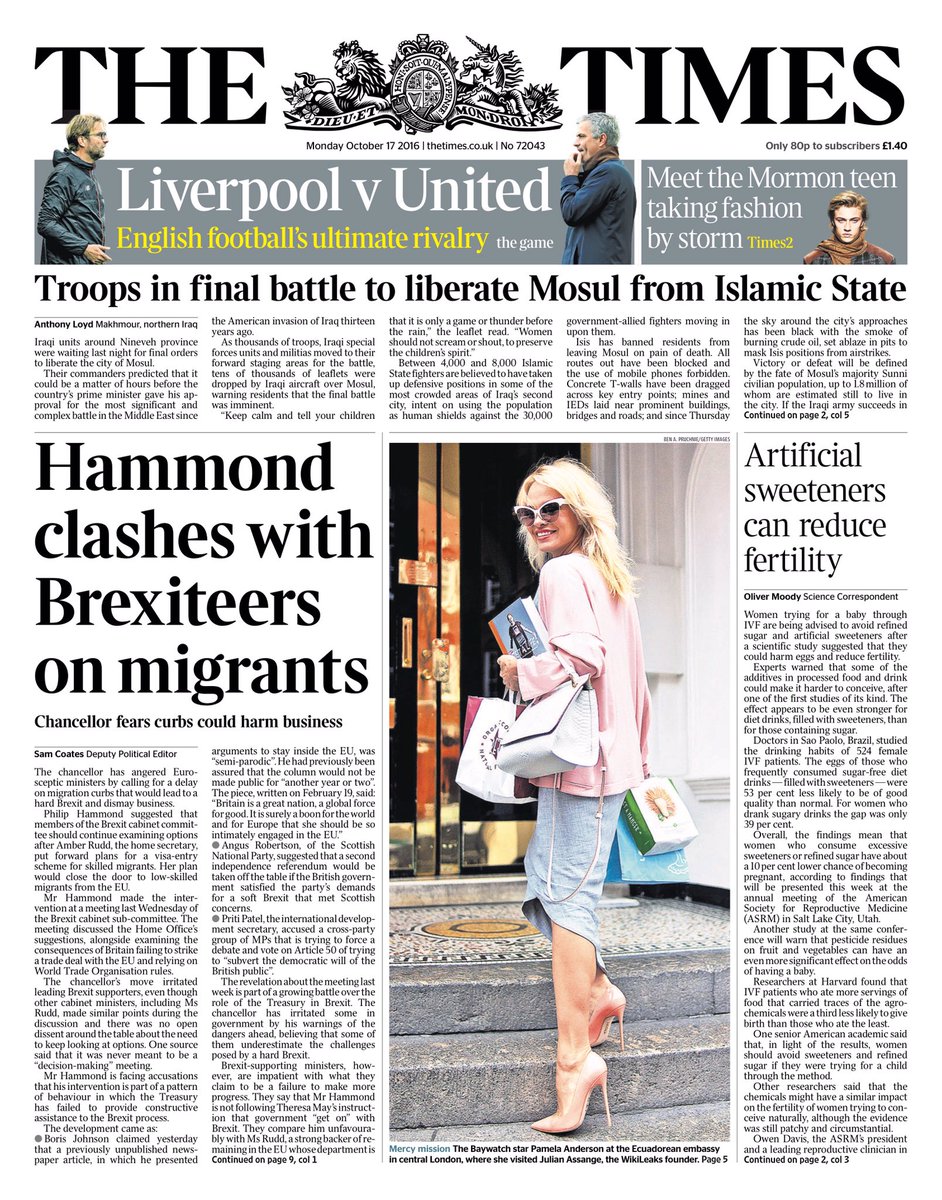
Monday’s front pages saw similar stories in two conservative newspapers relaying the anger of more staunchly pro-leave cabinet colleagues at Hammond reportedly questioning the wisdom of a rapid post-Brexit crackdown on unskilled EU workers arriving in the UK.

Nick Sutton (@suttonnick)

Monday's Times front page:
Hammond clashes with Brexiteers on migrants#tomorrowspaperstoday #bbcpapers pic.twitter.com/WnPOVPBSvd

October 16, 2016

May’s official spokeswoman didn’t deny there had been “lively debates” within the cabinet’s Brexit committee – whose 12 members are split evenly between leavers and remainers – but described these as a necessary way to thrash out the best consensus position.

But perhaps more uncomfortable for the government is that it is, at long last, facing some effective opposition to its “no running commentary” mantra as to what Brexit might mean.

Keir Starmer, the very able former director of public prosecutions recently named Labour’s shadow Brexit secretary, has already helped produce a probing list of 170 questions for the government over Brexit, forced May into permitting a debate on the strategy for leaving the EU – and used that debate to give the government an uncomfortable time about what it is up to.

You should also know that:

  • The high court began hearing a legal challenge to Theresa May’s plan to start the article 50 process of leaving the EU without a vote in parliament.
  • Brexit could hit Ireland harder than Britain, according to Irish leaders, who have called an unprecedented summit amid warnings of an economic “disaster” on both sides of the border.
  • The number of hate crimes leaped by 41% in the month after the Brexit referendum, Home Office statistics confirm.
  • Boris Johnson said the UK’s continued membership of the EU would be a “boon for the world and for Europe” in a previously unpublished newspaper column written days before the vote.
  • Eastern Europeans who work seasonally at UK farms fear for their livelihoods post-Brexit, while their employers fear a labour shortage.
  • There has been a huge rise in Britons applying for Irish citizenship, with the London embassy handling more cases in a month than in the whole of 2015.
  • Theresa May is to fly to India next month on a trip seen as a key test of her ability to win backing for future for post-Brexit trade deals.
  • A Conservative councillor from Surrey has called for support for the UK’s membership of the EU to become a treasonable offence.

Read this:

In the Guardian, Zoe Williams says the cabinet EU hardliners are not Brexiters but dangerous political extremists who have “nothing but their confidence”:

At Politico, Paul Taylor says Britain is hurtling toward the worst of all worlds – a swift, hard Brexit on unfavourable trade terms – and the government is suffering from worrying delusions:

In the Times (paywall), after Michael Gove accused the remain campaign of “slut-shaming” the British public, Matthew Parris offered an eloquent and passionate rebuttal, arguing Britain was heading for a worse disaster than Suez:

And back at the Guardian, a Dutchman, Joris Luyendijk, subjects us to another bracing blast of European realism, observing that in practice, Brexit will mean whatever the EU, not Britain, wants:

Tweet of the Week:

The prime minister of Luxembourg neatly explains just why it is that the EU-27 are so disinclined to listen once more to Britain’s very particular demands ...

POLITICO Europe (@POLITICOEurope)

Xavier Bettel on Brexit: “Before they were in and they had many opt-outs; now they want to be out with many opt-ins” https://t.co/jBhASFoKa5

October 11, 2016

WikiLeaks: Clinton avoided criticism of Wall Street in Goldman Sachs speeches

Alleged transcripts show Clinton said she worked closely with Wall Street as a senator and ‘the jury is still out’ on whether Dodd-Frank reforms were needed

Hillary Clinton avoided direct criticism of Wall Street as she examined the causes and responses to the 2008 financial crisis during a series of paid speeches to Goldman Sachs, according to transcripts released by WikiLeaks.

Three transcripts, released Saturday as part of the hack of her campaign chairman’s emails, did not contain any damning revelations showing she was unduly influenced by contributions from the banking industry, as her Republican opponent Donald Trump has said. Still, her soft-handed approach in the speeches may remind liberals of fears, raised by her former Democratic rival Bernie Sanders, that the party’s nominee is too close to Wall Street to be an effective check on its excesses if elected.

In October 2013, the transcripts show, Clinton told bankers she had “great relations” and worked closely with Wall Street as New York’s senator, and said “the jury is still out” on whether the Dodd-Frank financial reforms, enacted after the crisis, were appropriate. She said more openness from the start could have prevented the uproar on Wall Street over those reforms.

“What happened, how did it happen, how do we prevent it from happening? You guys help us figure it out, and let’s make sure that we do it right this time,” she told the bankers, according to the transcripts.

Working to relate her speech to her audience, Clinton likened her experience as secretary of state to finance, saying: “It’s like anybody’s balance sheet,” with both opportunities and potential liabilities. In one exchange, a conference participant from Texas told Clinton that she had “the honor to raise money for you” during her 2008 presidential campaign.

Clinton responded: “You are the smartest people.”

In the hard-fought Democratic primary, Sanders repeatedly called on Clinton to release the transcripts of her speeches to Wall Street, some of which earned her hundreds of thousands of dollars. In an ironic twist, the transcripts ended up becoming public because her campaign aides had distributed them among themselves in an effort to prepare for any attacks she might face. Those internal campaign emails were then leaked in the hack of campaign chairman John Podesta’s emails.

Clinton’s campaign neither confirmed nor denied that the speech transcripts and leaked Podesta emails were authentic. Clinton’s team has accused Russia’s government of hacking Podesta’s emails, and the Obama administration has formally blamed Moscow for a series of breaches affecting US political groups.

“There is no getting around it: Donald Trump is cheering on a Russian attempt to influence our election through a crime reminiscent of Watergate, but on a more massive scale,” said a Clinton spokesman, Glen Caplin.

The transcripts, all from 2013, include speeches and question-and-answer sessions with Clinton at a Builders and Innovators Summit, an Alternative Investment Management Summit and a gathering of CEOs, all hosted by Goldman Sachs.

In another speech, Clinton said that after 2010 leak of US diplomatic cables, she had to go on an “apology tour” while serving as Barack Obama’s secretary of state.

In those cables, US officials and diplomats characterized some foreign leaders as “vain, egotistical, power hungry, corrupt. And we knew they were. This was not fiction.”

“I had grown men cry,” Clinton recalled. “I mean, literally. ‘I am a friend of America, and you say these things about me?’”

Clinton said she apologized to world leaders by saying ambassadors “get carried away – they want to all be literary people”.

Lloyd Blankfein, CEO of Goldman Sachs, then told Clinton that she had put on “an Italian accent”.

“Have a sense of humor,” Clinton replied.

“And so you said, Silvio,” Blankfein answered, alluding to the then Italian prime minister, Silvio Berlusconi.

She praised other leaders, including Chinese president Xi Jinping, who had assumed power in the fall of 2012. Clinton described Xi as “a more sophisticated, more effective public leader” than his predecessor, Hu Jintao, and said that he could “work a room”.

“You can have him make small talk with you, which he has done with me,” she said.

Clinton also told bankers that she would have liked to see the US intervene in Syria “as covertly as is possible” – and complained about reports to the press.

“We used to be much better at this than we are now,” she said. “Now, you know, everybody can’t help themselves. They have to go out and tell their friendly reporters and somebody else: look what we’re doing and I want credit for it.”

Tuesday, October 18, 2016

Blue-Collar Businesses Pay Off for Entrepreneurs

Blue-Collar Businesses Pay Off for Entrepreneurs

Want to start a lucrative small business? Your best bet might be going into a blue-collar industry like construction, plumbing or electrical.

According to a study from Invoice2go, eight of the top 10 highest earning industries for small business ownership come from the blue-collar sector, and bill more than $5,000 per month on average.

Bob Briski, ‎director of data infrastructure at Invoice2go, said the study's results challenge the perception that you need a four-year college degree to be among the top earners.

"While society tends to push everyone to get a four-year degree, and typically take on a lot of debt in the process, we are seeing countless examples of people carving out a very successful path of their own, particularly in blue-collar industries," Briski wrote on the company's blog. "There's a lot of opportunity out there, and with new technology to make it even easier to thrive as a small business operator, it's ripe for anyone's taking."

For the study, researchers examined invoicing activity of more than 33,000 U.S.-based Invoice2go users. "Earnings" was determined by taking the median monthly dollar amount invoiced per month for each business account between January and September of this year. Invoice2go users are typically entrepreneurs, side giggers, and microbusinesses with less than five employees. [See Related Story: The 10 Best (and Worst) Cities for Starting a Business ]

Topping this year's rankings are construction small businesses, which invoice more than $18,000 a month. Based on the research, the top 25 earning industries for small business ownership in the U.S. and their monthly average invoices are:

  1. Construction: $18,788
  2. Roofing: $16,942
  3. Flooring: $10,602
  4. Painting: $9,486
  5. Heating and air conditioning: $8,971
  6. Carpentry: $8,950
  7. Plumbing: $8,639
  8. Electrical: $7,490
  9. Interiors: $7,347
  10. Audio: $5,587
  11. Pool services: $5,412
  12. Security: $5,283
  13. Repair: $5,195
  14. Handyman: $5,194
  15. Auto repair: $4,35
  16. Landscaping: $4,030
  17. Catering: $3,333
  18. Events: $2,963
  19. Design: $2,680
  20. Cleaning: $2,555
  21. Photography: $2,243
  22. Fitness: $2,000
  23. Technology: $1,895
  24. Beauty and salon: $1,500
  25. Bakery: $1,043

In addition to looking at specific industries, the researchers also examined which cities offer blue-collar businesses the greatest earning potential. The highest earning cities for blue-collar business in the U.S. and their average monthly invoices are:

  1. Raleigh-Durham, North Carolina: $20,318
  2. Houston, Texas: $17,219
  3. Dallas-Fort Worth, Texas: $16,085
  4. Portland, Oregon: $13,294
  5. St. Louis, Missouri: $12,692
  6. New York City, New York: $12,426
  7. Sacramento-Stockton-Modesto, California: $12,408
  8. Seattle-Tacoma, Washington: $12,018
  9. Charlotte, North Carolina: $11,628
  10. Miami-Ft. Lauderdale, Florida: $11,586

Despite the high invoice amounts, it is important to remember that these blue collar businesses might not be making the most profit, said Mark Bartels, chief financial officer at Invoice2go. He said contributing to the reason for blue collar businesses topping the list is because the cost of roofing and construction servicers, for example, are high. However, those businesses often have low margins.

"Remember, what invoicing value doesn't tell you is the underlying cost of goods sold associated with an invoice," Bartels told Business News Daily. "For example, building a $30,000 driveway may yield a smaller profit than someone billing for services like graphic design or consulting where the only cost of goods sold is the person's time and laptop. "

Wednesday, October 12, 2016

Labor poised to kill off marriage equality plebiscite when parliament resumes

Government attempts to shift debate to industrial relations likely to be overshadowed by same sex marriage and calls for banking inquiry

Labor is poised to kill the marriage equality plebiscite when federal parliament returns this week – with a final decision of the caucus due on Tuesday.

The Turnbull government will want to use the resumption of parliament after a three-week break to direct the political focus onto its industrial relations agenda – including legislation associated with the Country Fire Authority dispute in Victoria.

One Nation is also expected to reveal its position on the double-dissolution election triggers, the restoration of the Australian Building and Construction Commission, and the registered organisations legislation, over this coming week.

But the government’s efforts to move forward will be complicated by the almost certain defeat of the plebiscite, and the renewed political pressure the Coalition is likely to face about the banks after three days worth of hearings with chief executives in Canberra last week.

The government will take various marriage amendments to its party room this week, including a proposal allowing celebrants and ministers to refuse to officiate at gay weddings if they object on religious grounds – but these protections are not expected to be extended to service providers, like wedding cake makers or florists.

The comparatively limited nature of the exemptions from anti-discrimination law will likely not please everyone in the Coalition party room, even if the amendments ultimately prove to be hypothetical because of parliamentary opposition to the plebiscite.

Coalition sources have indicated privately they could have objections, depending on the detail of the proposal the attorney general, George Brandis, brings forward this week.

Arriving at the Canberra airport ahead of the new sitting week, Brandis launched a final appeal for Labor to support the plebiscite, saying it was the most immediate mechanism to deliver marriage equality. Brandis said if the issue was not resolved now, the debate would drag on for “years”.

“If Labor thinks this debate is divisive, why not get it over and done with,” he told reporters in Canberra on Sunday.

The Greens have flagged they will move to introduce legislation to the Senate this week that would set up a parliamentary commission of inquiry into the banks.

Greens finance spokeswoman Sarah Hanson Young said the inquiry would have similar powers to a royal commission, but it would not require endorsement from the executive.

The government is attempting to stave off pressure for a royal commission by drawing attention to its plans to establish a new banking tribunal to hear complaints from aggrieved customers.

Over the past week, to send a positive message about its responsiveness during the banking hearings, the government has made it known that the tribunal will work like an expanded ombudsman for aggrieved customers, so banks will not be able to appeal the tribunal’s decisions.

The banking industry will be required to pay for the new body. But the tribunal proposal is not expected to be finalised until next March.

Labor is yet to make a decision on whether or not to support the Greens proposal on the parliamentary inquiry for the banks, but the opposition will attempt to broaden the conversation about the banks to economic management in the wake of the treasurer Scott Morrison’s trip last week to New York, where he met ratings agency S&P.

The shadow finance minister Jim Chalmers said on Sunday the final budget outcome had confirmed a $35bn blowout in the deficit, and a $77bn blowout in net debt since the Coalition took office.

Chalmers said the chief economist of the National Australia Bank, Alan Oster, had warned that any downgrade of Australia’s triple-A credit rating would increase the wholesale funding costs for the banks by between 10 and 20 basis points, with flow-on consequences for home mortgages, which could see interest costs increase by more than $700 a year.

Chalmers said Labor, which agreed in the last parliamentary sitting week to the government’s omnibus savings bill, with measures worth $6bn, would “continue to lead the conversation when it comes to budget repair and will continue to provide the economic leadership the government has proved incapable of.”

On Sky News on Sunday, the finance minister Mathias Cormann said the Coalition had stabilised government spending. “So instead of continuing to increase – as was the trajectory under Labor – we have been able to stabilise it, and are now projected to bring it down.”

EU petition on Barroso's Goldman Sachs job signed by more than 150,000

Declaration says former European commission president ‘morally reprehensible’ for joining US bank

More than 150,000 people have signed an EU staff petition demanding that the former European commission president José Manuel Barroso loses his pension for taking a job at Goldman Sachs.

A delegation will present the petition on Wednesday to the main EU institutions: the commission, parliament and council, which represents EU governments.

Nearly 152,000 people have put their name to the declaration, which accuses Barroso of “morally reprehensible” behaviour over his decision to join the US investment bank. Since its launch by a handful of EU employees in July, the petition has spread far beyond Brussels staff, becoming a lightning rod for concerns about senior politicians taking lucrative private sector jobs.

The petition comes ahead of a keenly awaited investigation by an EU ethics committee into Barroso’s job. A three-person panel, comprising an ex-EU judge, ex-MEP and ex-official, will advise the commission on whether Barroso broke the EU’s code of conduct, which states that ex-commissioners must act with “integrity and discretion” during and after they have left office.

Barroso, who led the commission for a decade until 2014, took a job at Goldman Sachs in July to advise the bank’s clients on Brexit.

The current commission president, Jean-Claude Juncker, questioned his predecessor’s decision, saying he did not have a problem with Barroso “working for a private bank – but maybe not this bank”. The New York-based bank has come under fire for its role in helping the Greek government hide the extent of its budget deficit, as well as selling sub-prime mortgages, a trigger of the global financial crisis.

Juncker hits out at predecessor Barroso’s Goldman Sachs role

Barroso and the bank have strongly refuted claims of any unethical behaviour. Such claims are “baseless and wholly unmerited ... discriminatory against me and against Goldman Sachs”, Barroso wrote to Juncker in September.

Goldman Sachs has also stressed that it followed “strict rules” set by global regulators. “José Manuel took the role after an 18-month restriction period following the end of his term at the European commission, a longer period than that imposed by most European institutions”.

The EU staff, who have drafted the petition, are calling for tighter rules on politicians moving into the corporate sector, once they have left their EU jobs.

These calls have been broadly backed by the EU ombudsman, Emily O’Reilly, who has argued that the right to work should be balanced by “the public right to an ethical administration”.

Speaking to the Guardian and European newspapers recently, she said: “You could have a much stronger code of conduct pour encourager les autres.”

O’Reilly, who has also served as Ireland’s national ombudsman, argues the EU should eventually set up an independent body to oversee appointments of ex-officials, similar to Ireland’s Standards in Public Office Commission. “That is the natural progression, that it moves away from the commission and other institutions themselves.”

She predicted the Barroso case would have a permanent impact on the EU institutions. “Nothing has ever been so big, or has captured the public imagination in the same way. I think eventually this [case] will make the commission deal with the revolving doors issue in a more serious way.”

One of the petition organisers suggested their action had set a precedent that would make ex-politicians think twice before taking certain corporate jobs. “It is a precedent, in the culture of the EU institutions this will remain.”

The official said it was the first time EU staff had publicised criticism of their former bosses for actions, which they argue, have tarnished the EU’s image. “We are deeply committed to the European Union and we want to defend it.”

The petition organisers, who wish to remain anonymous, will be represented at handover by a group of retired EU officials and staff unions. At the same time, campaigners from Transparency International and the Alliance for Lobby Transparency and Ethics Regulation, will deliver a separate petition criticising the “revolving door between the European commission and big business”.

The commission’s ethics panel is also investigating Neelie Kroes, the former EU competition commissioner, who failed to declare a directorship in an offshore firm, in breach of commission rules.

The panel is expected to take around six to eight weeks to reach a conclusion on both cases.