20 Smart B2B Business Ideas in 2017


When the Bank of England looks around in a couple of years to replace Mark Carney as governor, Andy Haldane will need to work hard to win over the selection panel. The central bank’s chief economist can’t help attracting publicity, and not always in a good way.
Last week he was in hot water following his capitulation to the bullying Brexiters and their claim that experts were dunces. He said it was “a fair cop” in answer to critics who accuse his profession of missing the financial crisis and misjudging the impact of the Brexit vote.
The Bank certainly did fail to highlight the oncoming juggernaut of debt that overwhelmed the west in 2008. And now, post-Brexit, all is calm in the British economy where Threadneedle Street said there would be turmoil. As for a recession sometime soon, which the Treasury said was a possibility, there is not a sliver of evidence. If anything, the economy is one of the fastest growing in the developed world.
These specific errors call for an apology. Experts are under the spotlight now and need to examine their conduct, especially when they become partial and are undone by facts they sweep under the carpet or ignore.
But Haldane went further than just apologising for discrete mistakes. And worse, he made some bizarre comparisons that will make those concerned about the demise of experts think he is part of the problem.
He said that the 2008 crash was economic forecasting’s “Michael Fish moment”, referring to the BBC weatherman’s infamous dismissal of hurricane warnings in 1987 that were soon proved all too accurate across southern England.
He carried the analogy through to the Met Office’s solution, which was to include more data, more quickly, into its forecasting system. This brought about a huge improvement in weather predictions that economists could copy, claimed Haldane. Yet it is not clear why more data would make a difference when it was institutional myopia that was behind the Bank’s embarrassing ignorance of an unstable financial system in 2008.
Furthermore, Haldane said the forecasts of doom and gloom ahead of the Brexit vote were also wrong, even though the Bank was right about the fall in sterling and will be proved right about its limited impact on exports and significant impact on inflation, leading to slowing growth. It was only wrong about the strength of consumer borrowing, which was partly due to a misreading of the ultra-low loan rates on offer that make spending on credit so seductive.
Haldane’s Bank also failed to tell politicians, the City and the public that if there were a post-referendum panic, it would probably cut interest rates again and boost its stimulus package. The fact that it pulled the trigger on both these measures when the situation looked sticky is one reason consumer confidence has bounced back and the economy has recovered. He didn’t mention that either.
And he didn’t emphasise the inherent uncertainty surrounding economic forecasts. For instance, exports could be higher than expected, and the economy grow faster this year than the widely forecast 1%, as a result of the promised spending spree by Donald Trump when he gets into the Oval Office. All boats will float on a tide of US munificence that could scarcely have been foreseen last year, when the polls put Trump well behind Clinton.
Where Haldane hit the spot was in his critique of economics teaching. It is too narrow, it relies on equations to explain a world where many things don’t add up, and it lacks historical perspective.
Maybe universities can rescue the situation by developing a fresh cohort of economists with a broader and more grounded outlook. So Haldane may have been too harsh on his profession: but he is right that change is needed.
Was Mike Ashley’s new year resolution to stop being so conciliatory? That quality hasn’t often been attached to Sports Direct’s founder, chief executive and 55% shareholder but, by his standards, 2016 was a year of peace, love and reconciliation.
He turned up to Iain Wright’s business select committee, confounding some expectations. He apologised for “serious shortcomings” in working practices in the Shirebrook warehouse and launched a governance review. He pledged to raise standards, to offer all retail staff guaranteed hours instead of zero-hours contracts and that an elected workers’ representative would join the board. Ashley even held an open day at Shirebrook in September for all to witness the dawn of Sports Direct’s new “open and compliant” era.
And now? In the first week of 2017, Ashley performed three U-turns in one day. The first was merely odd: Sports Direct will resume share buybacks after abandoning them only a month ago. But the other two announcements suggested the old belligerence is back.
Ashley said he had asked chairman Keith Hellawell to reconsider his pledge to resign if outside shareholders vote against his reappointment next September. That was a big “up yours” to those who had just voted against Hellawell for a second time.
Then Ashley said the board would reconsider “all options” in its governance review “in view of continuing frustrations”. Whose frustrations? Outside investors’ or his? It wasn’t clear, but one option for the review is to abandon the idea of appointing an independent figure to lead it. Review arrangements are under discussion with the Investor Forum, representing City fund managers, and dialogue was described as “constructive” before Christmas. But that was before the latest vote against Hellawell.
Ashley could be making a mistake. A bunker mentality helped push Sports Direct into last year’s crisis. A big sulk wouldn’t improve matters now. Governance reform is harder that it sounds. Sometimes it involves hearing judgments you may not like.
Christmas is over – but not for City bankers. They are about to find out the size of their annual bonuses. The US banks traditionally go first: JP Morgan and Bank of America report results – and the size of their bonus pools – this week, with Goldman Sachs and Morgan Stanley to follow. All have sizable London operations. The European banks will follow suit a few weeks later.
Bankers insist that the bonus season is not what was it before the 2008 crisis. Then they got their payouts in lump sum cash amounts or, going back 20 years or so, in gold bars to take the sting out of taxes. These days bonuses are partly paid in shares and spread over a number of years. Even so, the rewards are big. Data for 2015 shows the big four US banks handing €1m to almost 1,000 City workers. The rainmakers are also raking it in. Three employees at boutique Robey Warshaw shared £37m for their efforts advising on big takeovers. That’s all their Christmases at once.
When thousands of bankers reportedly disappear, a special committee is called in to investigate. Will it solve the mystery and save the UK economy? Or have the City jobs vanished forever?
That all sounds like a case for superintendent Andrew Fenwick, the hero of the acclaimed crime novels of Elizabeth Corley, who in her far more tedious career is also vice-chair of Allianz Global Investors.
The premise would be quite neat, of course, as she will be up in front of the Treasury select committee on Tuesday, to talk about the UK’s future economic relationship with the European Union.
Corley’s appearance – along with HSBC chairman Douglas Flint and London Stock Exchange boss Xavier Rolet – comes as City firms hint that they are planning to shift loads of jobs to Europe in the wake of the UK’s Brexit vote (aka, seeing what concessions they can get out of the government).
Last week, Andrew Gray, head of Brexit at PricewaterhouseCoopers, which is advising several financial institutions on this matter, said announcements could start in late February. This must have rather irritated Corley’s fellow panellist Flint, whose bank once enjoyed a near-monopoly on making threats about leaving the UK. Now his rivals have brazenly nicked his ruse.
Another case for Fenwick, perhaps?
This week marks the start of the most serious banking stress tests of them all – the ones where the strain put on bankers’ braces, as they trouser annual bonuses, is scrutinised to the full.
Yes, it is the beginning of the banking reporting season, where no one takes much notice of profits, but instead focuses on the far more important issue of how much these delightfully self-effacing characters have earned for themselves.
JP Morgan kicks off a season that sees bankers sashaying along the corridor to the boss’s office to be given their “number” – a number that dictates what flash motor they can buy – and how much the rest of us love them for it.
Last year is not expected to be unveiled as a blockbuster for bonuses, but even average years for this trade look like stellar ones for mere mortals. Meanwhile, bonuses never seem to vanish when bankers make a complete Horlicks of things and shave a few points off GDP.
Or as JP Morgan boss Jamie Dimon, once put it: “I want to acknowledge our mistakes ... and try to stop stepping in dogshit – which we do every now and then.”
Total like-for-like sales were down by 0.1% in December from a very weak base of minus 5.3% in December 2015. At the time, that was the worst monthly result seen since 2008.
Yes – that’s the cheery new year’s message for the retail sector delivered by BDO on Friday, via its high street sales tracker report.
The gloomy news from the accountancy firm tied in rather neatly with a similar downbeat statement last week by Next – once the darling of the retailing sector – where boss Lord Wolfson’s usual cautious setting veered towards dejection.
Wolfson said that the slowdown in spending on clothing and footwear, which began in November 2015, was likely to continue this year, while the retailer’s post-Christmas sale (frequently cited as the textbook example of how to do such things) had flopped.
That doesn’t mean that everyone else on the high street had a shocker, of course, but we’ll have a better idea of who did after an action-packed series of announcements this week.
We have trading statements from Tesco, Sainsbury’s and Morrisons, plus a host of more general retailers including Joules, SuperGroup, Marks & Spencer, Debenhams, Booker, Ted Baker and Dunelm.

The competition watchdog has raised concerns that a takeover of a payments system by Mastercard could have an impact on the Link cash machine network.
The Competition and Markets Authority has given Mastercard a week to tackle its concerns that its takeover of Vocalink will restrict the number of companies able to provide systems to Link, which operates more than 70,000 automatic teller machines (ATMs) around the UK.
Andrea Coscelli, acting chief executive of the CMA, said: “The Link ATM network provides an essential service for millions of customers. It’s important that Link has a good choice of providers when it comes to supplying the necessary infrastructure so it can take advantage of the opening up of payment systems to competition.
“These concerns warrant a closer investigation in the event that Mastercard cannot address them at this stage.”
It was announced in July that the US card provider Mastercard would buy Vocalink, owned by a consortium of high street banks, for about £700m. At the time, Philip Hammond heralded the deal as showing international companies had confidence in the UK after Brexit.
Vocalink and Mastercard are two of three possible providers of services to Link, the CMA said.
The competition body did not find any concerns about the impact of the transaction on Bacs, the automated clearing service, or faster payments (FPS), which allows real-time payments between banks. It said there were many credible alternatives to Vocalink and Mastercard in these two areas.
Mastercard said: “We’re pleased to have the opportunity to address their one concern, regarding the Link ATM scheme, in the timeframe provided. This acquisition promises to bring greater choice and innovation to the payment ecosystem, enabling people, governments and businesses to pay the way they want to pay.”
The CMA said a number of industry participants had raised concerns with the transaction and it had investigated a number of theories of harm including loss of competition in payment infrastructure services to Bacs, FPS and Link.
The government has been trying to encourage competition in the mechanisms by which money is moved around the financial system, and has set up the Payments Systems Regulator to oversee the market.

A Cambridge University study has brought to light figures showing that black victims of fraud are more than twice as likely to be denied a refund by their bank as white customers. The notion that being from an ethnic minority would make your claim less believable is, on the surface, shocking. But given the stereotypes of ethnic minorities and a history of racial discrimination in the banking sector, these figures should not really come as a surprise.
One possible explanation for banks being less likely to believe ethnic minority customers is because of stereotypes in relation to fraud. When former prime minister David Cameron was caught telling the Queen that Nigeria and Afghanistan were “fantastically corrupt”, it highlighted the perceptions many have of the countries minorities have migrated or descended from.
As Prof Ross Anderson, who was behind the Cambridge study, has explained, “bank staff have the same prejudices as the general population”. Due to the nature of segregation in Britain, many people’s only experience of Nigerians, for example, may be the cliche of internet scammers, as explored in the Channel 4 documentary 419: the internet romance scam. There is clearly a lot of work that needs to be done for people to see past the stereotypes of minorities that we are often fed.
These latest figures highlight a much larger problem in the banking sector. We are quick to point to the police, schools and even universities as sites of discrimination, but there have previously been suggestions that banks are just as institutionally racist. In 2011 Nick Clegg highlighted the problem that ethnic minority businesses have historically had in receiving finance from banks, with black African businesses being four times less likely to be approved for loans, and all groups being subject to higher interest rates. When the government eventually published a report in response to these allegations it did not refute the figures, but argued that there was “no evidence to indicate that disparities are due to racial discrimination per se”. This is exactly how institutional racism works: the clearly discriminatory playing field is acknowledged and then rejected on the basis that there could be “other factors” at work.
To understand institutional racism means looking beyond simple notions of the banks, or bank staff, being racist. A routine way to dismiss claims of racism is to say that ethnic minorities tend to be more disadvantaged, and therefore are less likely to pass credit checks, which are essential to receive banking finance. But this way of thinking entirely ignores the fact that minority communities are more likely to be disadvantaged is in itself racism: we are poorer because we are darker. A lack of access to finance is a key cause of the staggering ethnic wealth gap, which further prevents people from owning homes and setting up businesses. These systemic issues are clearly about racial discrimination and the banking sector colludes in institutional racism if it ignores this to focus on “other factors”.
As far as we know Britain has never had overtly racist discrimination in mortgage lending as in the US, where African Americans were historically denied loans in certain “redlined” districts. However, there have long been complaints about lack of access to mortgages and credit from ethnic minority communities in the UK. This lack of trust in the banking sector was underscored by the 2008 financial crisis. Not only did the resulting austerity impact more on ethnic minorities but a major cause of the crisis was American subprime mortgage lending at high rates to African American communities. And when the housing bubble burst, the mass evictions of African Americans sent shockwaves through black communities in Britain.
A severe lack of faith in the banking sector to support minority communities has led groups to develop their own initiatives. In the African-Caribbean community, collective forms of saving such as a “pardner” are still common. People will pay money into the pardner regularly and each person takes a turn using the collective pot of money. Pardner money has been a vital source of financing things such as weddings, new businesses and house deposits. It also take a level of trust that belies the stereotype of the corrupt black community.
Ethnic minorities have also avoided using mainstream banks in order to try to get a better deal. Foreign institutions such as the Bank of India are becoming a feature in urban communities and people are also turning to credit unions. There are even a number of groups working towards building black-led financial institutions.
When faith in mainstream banks is so low that ethnic minorities are turning to alternative sources of finance, it is time to acknowledge a systemic problem. Having to fight to be believed when we are victims of fraud is just the latest example of the barriers facing minorities in the banking sector. A concerted effort needs to be taken by the banks and government to address the systemic racial inequalities in banking and access to finance.

Paul Flowers, the former chairman of the Co-operative Bank, has been dismissed as a minister by the Methodist church after he was convicted of possessing cocaine, crystal meth and ketamine in 2014.
In a statement, the church said: “Following the conclusion of our disciplinary process, Paul Flowers has been removed from the list of ministers of the Methodist church.
“Mr Flowers admitted a charge of ‘seriously impairing the mission, witness or integrity of the church’.”
Earlier he had been suspended pending a disciplinary hearing.
Flowers, 66, stepped down from his £132,000-a-year job at the Co-op Bank in June 2013 soon after a £1.5bn black hole in its finances was discovered.
Six months later he appeared before a Treasury select committee, where he was accused of not knowing the “very basic” details of the bank’s finances.
A few days later he was filmed apparently counting out £300 to buy cocaine and crystal meth in a drugs deal. After the Mail on Sunday was handed the footage and published a story, Flowers was nicknamed the “Crystal Methodist”.
In May 2014, he was fined £525 after pleading guilty to possession of cocaine, crystal meth and ketamine at Leeds magistrates court. The court heard that “stress and the care of his terminally ill mother [were] reasons for his drug use”. He was said to be remorseful and seeking professional help.
Following his conviction, he told the BBC: “I am in company with every other human being for having my frailties and some of my fragilities exposed. Most people get through their life without that ever coming into the public domain.
“I am no worse and no better it seems to be than any number of other people. But, of course, I have sinned in that old fashioned term, which I would rarely use, but I am like everybody else, I am frail.”
In an interview with the Guardian last year, he admitted to the repeated use of male escorts for “comfort and solace”.
Flowers had been a Methodist minister since 1976, and was a trustee of the body that manages the church’s funds and investments. He was suspended indefinitely in November 2013.
The church’s disciplinary body told Flowers of its decision to remove him last month. He did not exercise his right to appeal. He can no longer use the title “reverend” nor lead services.
On Sunday, Flowers denied he had been sacked. He told the Mirror: “I’ve not been dismissed. Bye, bye, God bless you.”

Scrolling through my online bank statements at Christmas, I was surprised to find I had not removed cash from an ATM for well over four months. Thanks to the ubiquity of electronic payment systems, it has become increasingly easy to glide around London to a chorus of approving bleeps.
As more shops and transport networks adapt to contactless card and touch-and-go mobile technology, many major cities around the world are in the process of relegating cash to second-class status. Some London shops and cafes are now, like the capital’s buses, simply refusing to handle notes or coins.
Could we see a whole city go cash-free? From Seoul to Bergamo, cities big and small are at the forefront of a global drive to go digital. Many of us are happy to tap cards or phones to hop on a bus, buy a coffee or pay for groceries, but it raises the prospect of a time we no longer carry any cash at all.
No spare change for the busker at the station, the person sleeping rough in need of a hot drink, the market trader, the donation box. Although even on-street charity fundraisers are now broaching the world of contactless payments, what might the rise of the cashless city mean for street vendors, small merchants and the poorest inhabitants?
Some experts now fear a two-tier urban realm in which those on the lowest incomes become disconnected from mainstream commercial life by their dependence on traditional forms of currency.
“The beauty of cash is that it’s a direct and simple transaction between all kinds of different people, no matter how rich or poor,” explains financial writer Dominic Frisby. “If you begin to insist on cashlessness, it does put pressure on you to be banked and signed up to financial system, and many of the poorest are likely to remain outside of that system. So there is this real danger of exclusion.”
Ajay Banga, Mastercard’s CEO, has spoken about the growing global risk of “creating islands, where the unbanked transact [only] with each other”.
In India, the question of how the poorest might connect with the digitised world of the middle-class consumer is now of central importance. In November, the prime minister Narendra Modi announced the removal of 500 and 1000 rupee notes from circulation. Part of a wider attempt to jolt the nation into joining the cashless revolution, Modi’s government believes restricting currency and pushing the take-up of electronic payment will help tackle corruption and regulate India’s untaxed, “black” economy.
Saurabh Shukla, the Delhi-based editor in chief at NewsMobile Asia, says he has seen many small “mom and pop” store owners introduce card readers and learn how to use Paytm, a mobile payment platform, over the past two months.
“They realise a big change is here and they are trying to adjust to electronic payment,” he explains. “But they still want to convert back to cash at the end of the working day or the working week. It will be a gradual adjustment. We might not be able to create a completely cashless India, but we can aim to create a low cash economy.”
Modi is encouraging state government to create “smart” cities by connecting their public services with the latest online technology. Officials are aiming to make the Chandigarh – famously designed by modernist architect Le Corbusier – India’s first cashless city by insisting all bills are paid electronically at government offices. And the government of Goa is attempting to turn its capital Panjim cash-free by offering discounts in digitally bought services like train tickets, and by setting up classrooms to teach small traders e-payment technology.
Yet huge queues remain outside banks as many Indians continue to demand cash. Some of the poorest street vendors cannot afford card readers, and have struggled to operate Paytm payment transfers on their mobile phones.
Aires Rodrigues, a human rights lawyer in Goa, says traders in Panjim are suffering. Rickshaw drivers and fish market sellers have been left with no way of accepting payment from middle-class customers now inclined to do everything digitally. “It’s senseless to try to make everyone go cashless,” says Rodrigues. “The government seems to have lost sight of the plight of the common man.”
If India’s urbanites are being forced to undergo digital shock therapy, city dwellers in much of Europe have been moving steadily away from cash. Consumers like convenience. Governments like the idea of tax transparency. And retailers like cutting down on the costs of cash handling.
According to a recent report by Fung Global Retail & Technology, nine of the top 15 “most digital-ready” countries are in Europe. It predicts Sweden could become the world’s first completely cashless society. Niklas Arvidsson at Stockholm’s KTH Royal Institute of Technology thinks it could happen by 2030.
Yet even Sweden has seen an enthusiasm gap emerge, mostly along demographic lines. Older people in the rural north, tending to be the least tech-savvy, resent the economic power of Stockholm and Gothenburg, now almost entirely cash-free urban zones. The National Pensioners Organisation is a key player in the “Cash Uprising” coalition now campaigning to make sure older Swedes can still deposit and remove cash from banks.
Wealth, however, remains the key factor in determining who might be entirely left behind by the evolving digital economy. Some of the poorest people in Europe’s richest cities have found themselves pushed aside.
In Amsterdam, homeless people selling street magazine Z!, the Dutch equivalent of The Big Issue, now struggle to find customers still using cash. Z! trialled card payments by giving a dozen of the city’s vendors iZettle readers back in 2013, but the method was deemed too cumbersome.
“After a few weeks, our vendors said, ‘Look, this is too complicated’,” says editor Hans van Dalfsen. “It became too clunky and time-consuming for the vendor to juggle their magazines, the card reader and their own mobile phone connected to Bluetooth – all that stuff was needed to carry out the transaction.”
Van Dalfsen says he is now talking to a major telecoms company to try to find a simpler way for homeless vendors to accept payment using only their mobile phones, perhaps with help of unique QR code on their ID badge.
“Like Scandinavia, we are close to being cashless in Amsterdam,” he says. “I’m an optimist, but we really need bright people in the tech companies to come up with simple, convenient solutions that work for everyone. We cannot let people become cut off from the life of the city.”
Like many of the world’s poorest people, much of Amsterdam’s homeless population remain without a bank account. So even if they own a mobile phone, most fall back to cash.
Kenya may offer a guiding light here, having found a way to allow unbanked citizens access into the cashless society using cheap mobiles. Launched in 2007, M-Pesa has become the world’s leading mobile money platform, allowing millions of users to transfer money to each other by sending text messages and store their funds digitally without opening a conventional bank account.
In Zimbabwe, last year’s cash liquidity crisis led to renewed distrust in the banks and helped mobile money platforms take off as an alternative way of doing business, first in the capital city Harare, then in rural areas. The country’s most popular text-based service EcoCash now has more than six million users.
“There has been a huge explosion in cashless payments, down to the very poorest street traders using mobile money solutions,” says Nigel Gambanga, a Harare-based technology analyst. “Everyone has begun to realise, ‘If I don’t figure this out, I might not be in business tomorrow.’ People are adaptable.”
Dave Birch, director of innovation at UK firm Consult Hyperion, thinks it would be foolish to insist on clinging on to cash on behalf of the poor. “If you keep people trapped in a cash economy, you leave them to pay higher prices for everything, you leave them struggling to access credit, and more vulnerable to theft,” he says.
“We’re going to replace cash with electronic platforms,” Birch adds. “I don’t think poverty or being unbanked is necessarily a barrier, because everyone has a phone. Given the technology we have, we can develop new ways of moving digital cash around, even on the most basic of phones.”
The challenge for banks, regulators, tech innovators and officials keen to push forward “smart city” initiatives, is to make sure evolving platforms are accessible and keep everyone interconnected.
If we cannot find a common payment ecosystem, we may find ourselves wandering through divided cities, separated by the sound of bleeps and the shuffling of cold, hard cash.
Follow Guardian Cities on Twitter and Facebook to join the discussion, and explore our archive here

Theresa May has been urged to stop the Green Investment Bank being “killed off” by a sale to private firm Macquarie, amid fears the assets will be stripped and its environmental purpose abandoned.
MPs from across the parties raised concerns about the proposed sale in the House of Commons, after Caroline Lucas, co-leader of the Green party, called a debate arguing the whole process should be stopped.
Nick Hurd, an energy minister, refused even to confirm that Macquarie was the preferred bidder, citing commercial sensitivity.
But Lucas launched into an attack on the Australian investment bank, saying it had a “very, very worrying and dubious track record”. She said: “This preferred bidder, Macquarie, not only has a dismal and terrible environmental record, it also has an appalling track record of asset-stripping. So why has the government given preferred bidder status to this company?”
She added: “Will the minister admit that this selling off could lead to the bank being fatally undermined as an enduring institution? Will he stop the killing off of the Green Investment Bank? Will he halt the sale process with immediate effect?”
The Green Investment Bank was set up under the coalition with £3.8bn of government money, with the aim of “greening the economy”, but George Osborne, the former chancellor, took the decision to sell off a majority share.
Hurd insisted independent trustees would have a special share to safeguard the environmental purpose of the bank under its new ownership. He also did not appear opposed to the sale of some of the Green Investment Bank’s assets after privatisation, saying: “Let’s not get into a position where we say holding on to assets is good in itself.”
Hurd said: “Potential bidders are interested in the Green Investment Bank precisely because of its green specialism. We are asking potential investors to confirm their commitment to Green Investment Bank’s green values and investment principles and how they propose to protect them, as part of their bids for the company.
“In addition, the government has approved the creation of a special share, held by independent trustees to protect Green Investment Bank’s green purposes in future. The sale is commercially sensitive, so I cannot comment on the identity of any bidders or the discussions taking place between the government and potential bidders.”
Hurd added: “It is precisely because we want the Green Investment Bank to be able to do more, unfettered from the constraints of the state, that we are seeking to put it into the private sector.”
However, Lucas’s concerns were echoed by a number of Conservatives. Peter Aldous, MP for Waveney, said the bank was a tremendous success story and catalyst for investment in the green economy. “There is a concern that it won’t be able to perform that role in future. Will my honourable friend consider a pause to the process?” he said.
Greg Barker, a Tory peer and former climate change minister, has also written to the prime minister urging her to reconsider over fears the state-owned green bank is not sufficiently protected against the risk of being broken up.
Clive Lewis, Labour’s shadow business secretary, called on the government to stop the sale entirely. “The Tories are reportedly preparing to sell it off to a well-known asset stripper, with no guarantees that its green purpose, or any kind of public influence, will be maintained,” he said.
“The government should stop the sale of the green investment bank today. Failure to do so will confirm that, however much they try to steal our clothes, underneath it’s still the same old Tories.“
Vince Cable, the Lib Dem former business secretary, has also written to the government arguing that the special share would not prevent a breakup.
A Macquarie spokeswoman declined to comment on the debate or reports about the future of the Green Investment Bank but pointed towards a statement about its record. The statement said: “Macquarie – and its managed funds – is one of the world’s largest investors in renewable energy, having invested or arranged more than £8.5bn of investment into renewable energy projects since 2010.”
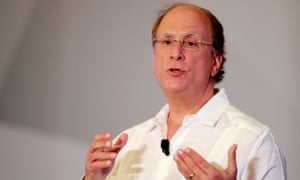
Among the 3,000 politicians, business leaders, economists and celebrities attending this year’s World Economic Forum in Davos will be a 64-year-old with receding hair and rimless glasses.
The academic demeanour of Larry Fink belies his role running BlackRock, an outfit he founded 30 years ago and which has become the biggest fund manager on the planet, overseeing $5.1tn (£4.2tn) of investments for pensioners and savers.
The sheer size of the operation – the UK economy is worth £1.8tn – puts Fink at the helm of an international powerhouse, with tentacles across markets for stocks and bonds around the globe.
In the UK alone, BlackRock is usually found among the top three shareholders in FTSE 100 blue-chip companies. Last week it pipped the UK government to become the biggest investor in Lloyds Banking Group.
While Fink makes regular appearances at major events such as Davos – this year he is to opine on the global economy – BlackRock is not known for its public pronouncements. It does not provide specific detail on its shareholdings in each company or offer opinions on individual investments.
However, there are signs that it may be about to become more vocal in public after its UK arm fired off a letter to the boards of the biggest 350 companies listed in London to urge them to rein in executive pay.
Signed by Amra Balic, its head of investment stewardship in Europe, the letter says: “We consider misalignment of pay with performance as an indication of insufficient board oversight, which calls into question the quality of the board. We believe that shareholders should hold directors to a high standard in this regard.”
The accompanying document puts board members on notice that they could face protest votes at annual general meetings.
Balic had signalled the letter was being prepared last month when she appeared before MPs on the Commons business, energy and industrial strategy select committee, which is examining corporate governance at a time when Theresa May has put executive excess back on politicians’ agenda.
BlackRock should carry clout, not only because of its size but also because 90% of its investments in listed companies are through tracker funds – positions it cannot sell even if it does not like the management.
In the 12 months to the end of June, it voted against 7% of pay-related resolutions, including Sir Martin Sorrell’s £70m pay deal at WPP and companies where pay deals were voted down such at engineering company Weir Group and the medical equipment group Smith & Nephew.
This expertise in index-tracking – known as passive investment – helped it win business in 2016, when it attracted $202bn of new funds.
BlackRock was launched in 1988 when Fink and seven others set about creating a fund management house that specialised in investing in bonds, with the support of the Blackstone private equity firm.
It was part of the US financial firm PNC by 1995 after Fink parted ways with Blackstone’s Steve Schwarzman. BlackRock floated in New York four years later and, apart from taking a dive during the 2008 financial crisis, its share price has been on an upward trajectory ever since.
A series of deals followed, notably including with Merrill Lynch over its fund management arm in 2006, and later the acquisition of Barclays’ fund management arm in the depths of the financial crisis. The takeover of Barclays Global Investors in 2009 brought with it iShares, a business that specialises in exchange traded funds (ETFs) that track markets. There have been concerns that funds such as these could create systemic risks by accentuating market moves during times of stress.
BlackRock is also known for a risk-management system known as Aladdin, used to monitor risks posed by changes to interest rates and other factors that can affect the value of investments.
Last year, it came under fire for failing to clamp down on boardroom excess. Steve Silberstein, the founder of computer company Innovate Interfaces, took issue with BlackRock’s voting record in the US and started a petition to urge the company to take a more aggressive approach. His resolution at BlackRock’s annual meeting last year got the support of just 4% of shareholders.
In the UK, BlackRock’s rivals wonder whether the $26m paid to Fink last year will stand in the way of its calls on leading companies to rein in excess. Insiders rubbish the idea – and point out that measuring impact by voting records does not take account of the behind-the-scenes talks with companies to avert showdowns at annual meetings.

Have you ever dreamed of being a fashion designer? Maybe you could never find clothes you liked so you made your own, or maybe you fell in love with your home-ec class in middle school. However this path started for you, it has the potential to end in a successful fashion brand.
You might not be showing your line at New York Fashion Week, but you can still create and launch your own line. The founders of independent clothing lines shared their secrets to success.
Matthew Johnson, owner and designer at Seventhfury Studios and Seventh.Ink Shirts and Apparel, founded Seventh.Ink in 2007 as a way to showcase his artwork on clothing. Before he began producing and selling his shirts, hoodies and accessories, which includes patches, pins, and art, he took the time to learn everything he could about the fashion industry.
"It really does pay to do your research," Johnson told Business News Daily. "Read articles and interviews from your favorite brands, talk to those brands and check out websites like How to Start a Clothing Company (HTSACC) to get as much insight as you can."
In an article for Entrepreneur, contributor Toby Nwazor said that knowing where to produce the clothing line is an extremely important decision because the clothing line's initial quality will be what the business' reputation is based on, for better or for worse.
The fashion market has always been a crowded one, so to stand out, you need something truly unique. Albam Clothing, a U.K.-based menswear brand started in 2006, started with co-founder Alastair Rae and his business partner designing with eight original styles, which would become Albam's line of high-quality men's fashion.
"The idea was borne out of a joint frustration that we had over the price and quality of men's clothing available at the time," Rae said.
Albam's success stems from its founders' dedication to producing something different than what was out there on the market. Similarly, Johnson stressed the importance of bringing something fresh to the table.
"If you squeeze out the same thing that everyone else is making, people are going to go with the existing brand instead of you," he said.
To build up your initial inventory, you'll need the money to produce it. HTSACC defines an "indie" clothing line as one that wants to produce high-quality products and plans to expand in the future once the brand grows. The site estimates that indie brands need a minimum of $500 to get going. If you want in-house production, it could take as much as $10,000 in startup costs. Five hundred dollars to $2500 is usually where most indie brands land.
"I ended up doing preorder designs once I got the hang of the business," Johnson said. "I was able to get an idea of what was selling and have the funds up front to pay for production."
Nwazor wrote that to ensure a profit, the entrepreneur must establish wholesale and retail rates higher than the expenses. A target for these rates would be to earn a profit margin 30 to 50 percent higher than associated expenses, he said.
Making your own clothes by hand is fine when you only have a few customers, but as your brand grows, you may need to outsource in order to scale your operation. Johnson enlisted the help of a screen-printing friend to produce the clothing for his Florida-based company. Rae, on the other hand, was developing new fabrics for Albam clothes and wanted to find local manufacturers right off the bat.
"A big challenge for us was convincing factories that we were serious about manufacturing in the U.K.," Rae said. "They were not used to new businesses approaching them."
To prepare for manufacturing, Nwazor suggested securing capital through investments from others, typically loans, or from the entrepreneur's personal money. The initial investment will range from a few hundred dollars to several thousand, depending upon inventory and quality.
Knowing how to market is critical for success. Having a good website for you brand makes it easier for customers to shop for your products, but advertising is what drives them to the site. Johnson quickly learned that paid advertising just wasn't worth it. [See Related Story: When Customer Loyalty Isn't Enough, Turn to Word-of-Mouth]
"I realized that word of mouth was the best way to spread the news about my brand without dropping a lot of money," he said.
Nwazor agrees that a great online presence is important.
"You have a lot to lose if you don't move your business online, because the online commerce market is more important than brick-and-mortar location," he wrote.
"Listen to your customers' feedback," Rae advised. "Don't be afraid to remake old styles that customers are asking for, or kill a best-seller if it feels like the right thing to do."
Johnson also recommended getting customer input before making major changes, and if you do modify your brand, do it slowly.
"A sudden switch is not only going to make customers question [your brand], but it'll likely cause sales to plummet because people have a tough time with major changes when they have a good thing going," Johnson said.
Like any startup, clothing lines take a lot of hard work and dedication. You will meet some challenges along the way, but if you believe in yourself and your brand, you'll succeed.
"Owning a clothing line isn't an easy or glamorous endeavor," Johnson said. "It's tough work that pays off successfully if you give it your all and enjoy what you do."

Want to be an entrepreneur? You don't necessarily have to start and build your own brand-new business; sometimes the best move is to buy and grow an already-established company.
Aspiring owners who don't know where to start should consider looking into websites, which direct you to the best businesses and properties for sale. From there, you can decide which best fits your entrepreneurial goals and budget.
Here are seven companies to find a business to take over:
BizBuySell.com boasts that it is "the Internet's largest business for sale marketplace" and offers users options to buy a business, buy a franchise, sell a business, get help with financing and more. Users can search for businesses by category, state and country, and even set a minimum and maximum price. You can also search franchises by type, state, and amount of capital you have available to invest. Or, you can search for a business broker near you.
Search on BizQuest.com for your desired businesses, franchises or business brokers by location and business type or industry. And perks for sellers are good, too: BizQuest.com allows you to post ads in just five minutes. The ads are then shared on the company's partner websites, like The Wall Street Journal and The New York Times. BizQuest.com also gives you the option to browse listings in top cities as well as the most popular franchises and industries.
BusinessBroker.net has more than 30,000 business-for-sale listings just waiting for you to sift through. As with the other websites, you can search for businesses and franchises, find brokers and see listings by industry and location. BusinessBroker.net also has a finance and loan center that offers professional help to guide you in your business purchasing decisions.
MergerNetwork.com has more than 15,000 active business-for-sale listings around the world. It allows sellers to post ads for their business for free and connect with over 14,000 entrepreneurs, investment bankers and business brokers.
This website currently has more than 62,000 business listings in the United States and around the world, including available franchises. Users can search by business sector and location to find the perfect business for them. BusinessesForSale.com also has features like email alerts and a services directory for those who need accountants, brokers, lawyers and more.
With more than 800,000 listings available, it's easy to understand why LoopNet.com is a reliable resource for discovering businesses for sale in your region. If you're already a business owner or an entrepreneur with a busy schedule, LoopNet is available in app form (on Google Play and in the App Store) to peruse listings on your schedule, from wherever.
Additionally, the site is partners with commercial real estate firms like Century21, Chusman & Wakefield, CBRE, Sperry Van Ness, and Re/Max Commercial.
On the other end of it? If you're looking to sell your current business, LoopNet provides the opportunity to list your business.
BusinessMart.com, like many of the other websites, has both businesses and franchises available as well as resources and services to help you get funding. It also allows you to search by location and business category, or search franchises by your available capital.

Monte dei Paschi di Siena’s attempt to float itself off the rocks with private capital appears doomed and a state-sponsored bailout looks inevitable. The Italian government on Wednesday granted itself the funds for a rescue package. The deed will probably be done by Christmas, with losses imposed on junior bondholders.
It is tempting to think this outcome was inevitable. The crisis at Italy’s third-largest lender has bubbled away for most of 2016 and the bank has a long and grim record of disappointing its backers. Over the past five years, it has raised €8bn in capital but churned out losses of €15bn.
But, turn the clock back just a few months, and there were realistic hopes that recapitalisation by the private sector would succeed. The Siena-based lender was bottom of the class in the eurozone’s regulatory stress tests in the summer but a few Greek banks have proved it is possible to find brave investors willing to take a punt on recovery.
MPS also seemed to have acquired two ingredients it had previously lacked – a credible chief executive and a serious cost-cutting plan. Marco Morelli, a former Bank of America executive, arrived in September and outlined his ambition to cut 2,500 jobs and a quarter of the branches. If recapitalisation could be achieved, said Morelli, MPS would emerge at the end of 2019 with one of the healthiest capital ratios among European banks.
And why not? Italy is not Greece. Half the country is rich. It ought to be possible for a bank founded in 1472 to shuffle off its bad loans, even at depressed prices, overcome its foolish acquisitions from the boom years and regain a profitable niche. The critical sum at stake in the recapitalisation plan – €5bn – was not off the scale and JP Morgan, the Wall Street powerhouse advising MPS, was on hand to round up a few so-called anchor investors.
It has not worked. The immediate reason is that the anchor investors, supposedly from Qatar and China, have got cold feet. Meanwhile, junior bondholders have squealed at being asked to turn their IOUs into equity. In other words, confidence drained away, not helped by MPS’s warning that its levels of liquidity were falling fast.
But the other trigger was the landslide defeat for prime minister Matteo Renzi in the referendum on constitutional reform. That reopened the debate about Italy’s long-term future in the eurozone. Until the elections are held and the political picture clears, investors seem to have decided that Italy is not a place to take a high-risk bet.
January’s planned €13bn recapitalisation of Unicredit should still be safe. Unicredit is bigger, its bad debts are less severe and underwriters are already in place. But Italy’s political class should be alarmed by MPS’s failure to find private-sector friends. Bigger challenges have been overcome during the eurozone’s many crises. This state bailout looks like investors’ vote of little confidence in Italy.
The sins of Serco and G4S, circa 2013, were grave. The companies had been billing the government for placing electronic tags on offenders who were dead or in prison. They were told to engage in “corporate renewal” – in other words, get their houses in order – and they would be banned from bidding for public sector work in the meantime.
The response was reasonable and appeared to have the desired effect. The companies reformed their boards and audit committees to try to ensure that such a scandal could never happen again. Six months later, the bans were lifted, which also seemed roughly right. Outsourcing is designed to save money for the public purse and Serco and G4S, love them or loathe then, are two of the biggest operators in the country. So best to have the duo, in scrubbed-up form one hopes, in the market to keep the bidding competitive.
Now Deloitte has similarly been banned from bidding for central government contracts for six months. Or, rather, the consultant has volunteered for punishment. Has it also ripped off taxpayers for millions through deceit or incompetence?
Not at all. All that has happened is that one of its consultants wrote a two-page internal memo suggesting the government had no plan for Brexit, which is hardly a controversial opinion, and that civil servants are struggling to cope with the extra workload. But Deloitte thinks it needs to apologise for the “unintended disruption ... caused to government” by a leak to the Times. It wants “to put this matter behind us”.
This affair is ridiculous. The partners of Deloitte come across as lily-livered. And Theresa May, in apparently endorsing the six-month ban, appears terrified of criticism. Outsiders will draw a simple conclusion from the colossal over-reaction: the memo was on the money.
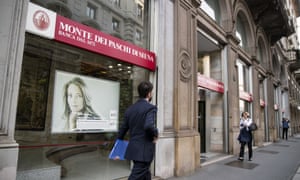
The Italian government has agreed to a bailout of Monte dei Paschi di Siena (MPS) after the world’s oldest bank admitted that it had failed to raise €5bn (£4.25bn) from private investors as part of a last-ditch plan to rescue the bank.
Paolo Gentiloni, Italy’s new prime minister, announced in the early hours of Friday that his cabinet had agreed to the rescue and would be dipping into a €20bn fund that had already been approved by the parliament earlier this week in the event that MPS needed to be saved.
The government announced that its first step would be to strengthen the bank’s ability to procure liquidity. If necessary, the bank can move ahead with a sale of state-backed bonds.
Pier Carlo Padoan, the finance minister, did not specify how much the rescue would cost the Italian state, but he said funds would be sufficient to cover the bank’s capital requirements.
“This will secure MPS’s capital needs and allow the bank to continue its industrial plan. Italy’s third largest bank will finally return with force to operate in support of the Italian economy and in a contest of full tranquillity for its savers and its employees,” Padoan said.
The government said junior bondholders – who under new EU rules must take a hit before any state intervention – would be able to convert their bonds into shares, which will then be converted into senior debt.
The announcement brought to an end months of uncertainty about MPS’s fate after the bank embarked on an attempt to first raise billions of euros on the private market. In a statement on Thursday night, MPS said that the attempt “has not ended with success”.
“In particular, there were no manifestations of interest on the part of an anchor investor who could have put a significant investment in the bank and this negatively affected decisions of institutional investors,” MPS said.
MPS’s board met on Thursday night after it failed to secure an anchor investor, thought to be the Qatar sovereign wealth fund.
Within hours of that announcement, Gentiloni convened his cabinet and formally approved the state rescue plan.
The bank also announced that the two investment banks that tried unsuccessfully to arrange the private investment – JP Morgan and Mediobanca – would not receive any fees for their work.
Shares in the bank were volatile during the day, lifting off record lows but then falling back in the confusion surrounding the next steps. The shares – down 85% this year – slumped by 7.5%. MPS is under instruction from the European Central Bank to bolster its finances after it was found to be the weakest of 51 European banks subjected to stress tests.
The failure to convince Qatar to inject up to €1bn means that Italy will have to impose losses on bondholders before it can stump up cash because of new EU rules intended to prevent taxpayers from picking up the bill for bank losses. However, about €2bn of the bonds are held by private investors, and the government suggested that arrangements were in place to protect those junior bondholders.
The bailout is not just a financial issue. It is also expected to have political consequences for Italy’s controlling Democratic party and Matteo Renzi, the former prime minister who stepped down from office earlier this month after he was roundly defeated in the referendum on 4 December. While Gentiloni has taken over as interim prime minister, Renzi is expected to run for election again as early as next year.
Wolfango Piccoli, an analyst with Teneo Intelligence, said a government rescue might not be immediately damaging politically, in large part because public attention will be diverted from the issue during the Christmas period. But the issue could become “politically toxic” later, once it becomes clear how many of the bank’s junior bondholders are eventually compensated for their losses, and how long it takes for them to be paid.
“In terms of the junior bondholders, let’s see what happens. it will eventually be decided by Brussels,” Piccoli said. Once MPS is saved, a number of other banks could also require government support.
“This will drag on for some time. If we have elections in May or June, it will be used then [against Renzi’s Democratic party], and there is no way to deflect that,” he added.
The bail-in of bondholders should help reduce the amount of funds the Italian government must contribute to MPS.
Analysts at Barclays said any state intervention for MPS may not be enough to solve the problem facing the banking system, which has amassed bad lending at a time when the economy has been stagnating. They said the six largest banks could need €30bn to clean up their balance sheets and even if the €20bn “were to represent sufficient firepower to plug the hole, we doubt the decision to deal with MPS through a public sector solution will represent a template to be unrolled across the system quickly”.
The €5bn fundraising from private investors was complex, involving a cash call on shareholders, asking bondholders to swap their investments for equity, and also parcelling off bad debts. The €4.25bn Atlante fund – set up by Renzi and backed by larger banks to prop up banks – had been expected to hoover up the problem loans.
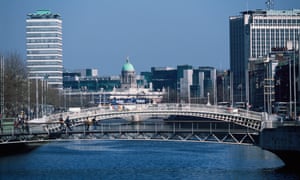
Banks and financial institutions make up the overwhelming majority of more than 100 companies inquiring about relocating to Ireland after Brexit, the head of the agency tasked with bringing foreign investment into the republic has confirmed.
Martin Shanahan, the chief executive of the Industrial Development Agency (IDA), said many of the corporations looking to move were based in the City of London.
Shanahan said that while Ireland would try to make capital out of the UK voting to leave the EU, Brexit was not the outcome he or anyone else in Ireland favoured.
He also said the IDA did not fear a Trump presidency would shut down American multinational investment into Ireland.
The IDA has a target to create an extra 80,000 jobs in the country by 2019, many of them from new US firms setting up their European base in Ireland.
Shanahan told the Guardian that Ireland’s low 12.5% corporation tax remained sacrosanct as one of the Irish Republic’s key fiscal policies.
Ireland will be the only English speaking country left in the EU after Brexit, giving Shanahan and his IDA colleagues extra impetus in their attempts to woo companies, some of which are based in the UK.
He said: “We have seen a huge increase in the amount of inquiries and activities across the globe. It’s not just our office in London, or our office in Dublin; we are receiving inquiries in Asia, in the US, in New York in particular. The figure that we have used to date is over 100 related inquiries.”
Shanahan continued: “For the financial services sector it is the fact that they need to have access to the European market and they need a jurisdiction in which they can do that. Ireland is extremely attractive because we are English speaking, have a common law system, there is the close proximity to the UK.”
On the threat of Trump imposing protectionist barriers to US companies locating abroad, the IDA chief executive said: “US companies, in my view, will continue to want to … go abroad, seek new markets, seek the talent that exists abroad and have access to the innovation and research that exists outside the US. I don’t see any kind of scenario where that isn’t the case.”
Shanahan stressed that the instability and uncertainty of global politics, from Brexit to Trump’s election win, might actually benefit Ireland.
“In the context of a very turbulent world Ireland looks very stable economically because of the strong growth in 2014, 2015, and it looks the same in 2016. And we look very stable from an enterprise and policy perspective as well.”
Despite criticism from fellow EU nations such as France that Ireland operates sweetheart tax deals for some of the biggest corporations on the planet, Shanahan predicted there would be no change to the 12.5% corporation tax regime.
“Investors place great store in the fact that Ireland has been unwavering and consistent. They know exactly what they are getting, the fact that it is 12.5%. I do not see any circumstances, and this has been confirmed by the minister for finance, Michael Noonan, that it will change any time in the near future, or even the long-term future for that matter,” he said.

The financial crisis of 2008 gave a big boost to the global standard-setters. Suddenly the Basel committee, which sets the standards for international banking supervision) was leading the financial news.
Dinner parties in Manhattan and Kensington were consumed with the finer points of Basel II and the evils of procyclical capital requirements. Governments that had been suspicious of international interference were eager for tougher rules to prevent banking crises from spilling across borders and infecting others.
The consequences of this enthusiasm were the creation of the Financial Stability Board (FSB), born out of the ashes of the Financial Stability Forum, at the G20’s London summit in April 2009, and inclusion of representatives of all G20 members among the key rule-makers in Basel and elsewhere.
The G7’s domination gave way to the hope that broader membership would produce more comprehensive buy-in and stronger political support for increasing the banking system’s capital.
All this change has worked, up to a point. The Basel III regulations, for example, more than doubled the capital an individual bank should hold, and enhanced the quality of that capital. The system looks somewhat safer as a result. But now there are dangerous signs that the commitment to stronger global standards – indeed, to any common standards – may be on the wane.
Many predicted this trend, but for the wrong reason. Sceptics warned that it would be harder to reach agreement among 20 or more countries than it had been among the dozen pre-crisis Basel committee members (mainly European countries, with only the US, Canada, and Japan representing the world beyond).
In practice, that has not turned out to be a major problem. Basel III was agreed far more quickly than Basel II was. Political pressure from finance ministers, expressed through the FSB, proved effective.
In fact, recent tensions have been more old-fashioned, pitting the US against the eurozone, with the UK and others stuck in between. The US has been pressing for tighter controls on banks’ internal models, and for a limit on how much a bank’s models can reduce its assets on a risk-weighted basis.
Agreement on these so-called output floors has so far proved impossible. The Europeans argue that their banks’ corporate lending is inherently less risky. After all, EU banks lend more to higher-rated, large companies, which access US capital markets, rather than borrowing from banks.
They also hold more low-risk mortgages on their balance sheets, in the absence of a European equivalent of Fannie Mae and Freddie Mac, America’s two quasi-public mortgage banks, which hoovered up securitised US mortgages.
At its meeting in Santiago, Chile, in November, the Basel committee conspicuously failed to agree on a solution, and kicked the issue upstairs to the committee of governors and heads of supervision, which will try again in January.
They will probably find a way to thread this particular needle. But the future for global standards looks more uncertain than it has for some time. Since the 2008 crisis, many countries, while ostensibly supporting the development of tighter global rules, have been taking other measures to protect their own financial systems.
The collapse of Lehman Brothers and others showed, in the former Bank of England governor Mervyn King’s memorable phrase, that big banks are “global in life, but national in death”. In other words, when a global bank crashes, the host-country regulators must pick up the local pieces.
That’s why requirements to establish local subsidiaries, with local capital, have been adopted. Gone are the days when banks could set up branches all over the planet, with support from the parent’s balance sheet. Subsidiarisation is now the rule.
Looking ahead, we can see that the two biggest players in the FSB and Basel have other preoccupations. Donald Trump’s incoming US administration has already signalled its suspicion of foreign entanglements and international commitments.
Making America great again is not likely to involve new enthusiasm for more intrusive rules made in Basel. Those who advocate rolling back much of the 2010 Dodd-Frank financial-reform legislation, in favour of a higher leverage ratio, as promoted in a bill advanced by Representative Jeb Hensarling, envisage a “Made in the USA” version of banking regulation. But, while the idea has some merit, it would not sit easily within the current Basel framework.
Europe faces other worries. Regulators there are now keenly focused on the implications of Brexit, which will require complex arrangements to manage a new relationship between London and the eurozone. The top priority for the European Central Bank must be to preserve the integrity of the EU banking union, which is under pressure from both Brexit and the crisis gripping Italy’s banks.
Against this background, it will be a challenge to retain the primacy of global standards and to secure continued buy-in to the Basel process. The Bank for International Settlements’ new general manager, Agustín Carstens, a former governor of Mexico’s central bank, will have a key role to play, as will whoever replaces Mark Carney – the governor of the Bank of England – next year as chairman of the FSB. It is likely, too, that there will soon be a new chair of the Basel committee itself. Stefan Ingves of Sweden is due to step down in June.
These three new leaders will need all of their diplomatic skills to navigate treacherous political waters. The stakes are high. If the commitment to global standards wanes, everyone will suffer in the long run. Countries will impose incompatible local requirements, which will reduce the efficiency of capital utilisation and make the system less robust in the event of renewed financial instability.
© Project Syndicate

Monte dei Paschi di Siena’s claim to be the world’s oldest surviving bank dates to its origins in 1472 in the Tuscan city from which it derives its name. At the time, Siena was a republic and the institution was created to offer loans to “poor or miserable or needy persons”.
In the intervening 544 years, the prospects of the bank and the city of Siena became entwined. By 1624, a decision by the Medici Grand Duke to guarantee accounts held at MPS laid the foundations of the deposit protection schemes that are now used to provide confidence to savers in the banking system worldwide. The Grand Duke used the proceeds of pasture he held in the Maremma, in south-western Tuscany, to provide the guarantees.
For centuries, the bank had a reputation of being conservatively run, if generous to the local economy. The bank funded businesses, charities and supported the famous Palio di Siena horse race. Until recently, it was said that the population of Siena either already worked for the bank, aspired to do so, or were already drawing their pensions from it.
But its problems have mounted since the 2008 banking crisis, when it paid €9bn (£7.6bn) for Banca Antonveneta. The deal doubled its size and turned it into Italy’s third largest bank behind UniCredit and Intesa Sanpaolo. Its seller was Santander, which acquired the Italian bank during the three-way bid for Dutch bank ABN Amro, the roots of which lay in the taxpayer bailout of Royal Bank of Scotland.
Three years ago the problems escalated. The Sienese bank asked the government for €4bn amid a scandal over loss-making derivatives contracts and alleged fraud.
The Italian government already has a 4% stake even before the latest bailout is agreed, most likely in the next 48 hours. A poor score in the heath checks introduced since the banking crisis - it was the weakest out of 51 tested across the EU - has sparked the latest demand for €5bn of fresh funds.
Barclays is refusing to settle with the US Department of Justice over allegations it deliberately sold mortgage bonds to investors that it knew contained “craptacular loans”.
The DoJ’s legal filing outlines an array of colourful descriptions of the types of mortgages that it alleges were used by Barclays to package up in bonds – known as residential mortgage bond securities – which could be sold on to investors.
It accuses Barclays of selling investors RMBS “backed by loans it knew were made to borrowers who were not creditworthy and which were supported by house appraisals it knew were inflated”.
The DoJ said Barclays was not lending to customers itself but using loans from mortgage lenders Fremont, New Century, WMC, Countrywide, and IndyMac as the basis of the bonds it was selling.
To support its case the DoJ published conversations between bankers which it claimed proved they knew they were selling poor investments. They included:
• One Barclays banker in charge of reviewing the deals observed that one loan pool was “about as bad as it can be”.
• On another occasion, the same banker said this “scares the shit out of me”. He also remarked about a package of loans from Wells Fargo that “we have to eat their shit loans”.
• A Barclays salesperson described “the deluge of Fremont garbage being put out there”, the DoJ said.
Barclays, becoming the first major lender to fail to reach a settlement with the DoJ, said it rejected the claims made in the complaint. “Barclays considers that the claims made in the complaint are disconnected from the facts. We have an obligation to our shareholders, customers, clients, and employees to defend ourselves against unreasonable allegations and demands. Barclays will vigorously defend the complaint and seek its dismissal at the earliest opportunity,” the bank said.
The filings do not contain any clues about the size of the settlement that the DoJ was hoping to reach with Barclays, although the bank is thought to have been prepared to pay up to $2bn (£1.6bn). There are reports the DoJ wanted double that amount.
The DoJ said one of the companies conducting analysis for the bank, Valuation Stream, referred to “craptacular loans” that sellers such as New Century were originating to keep up loan production as the application volume began to decline.
The language used by bankers has been exposed in the past, notably in 2012 when the bank was the first major lender to be fined for rigging Libor. Then, the City regulator published email exchanges in which Barclays staff were offered bottles of Bollinger champagne as payment for favours, or their names printed in “golden letters”. Other exchanges involved emails in which traders remarked “always happy to help,” “for you, anything,” or “done … for you big boy,” after submitting rates that were incorrect.

Britons are bracing themselves for a Brexit-related slowdown in 2017 by stashing away cash at increasing rates, according to the latest snapshot from the UK’s high street banks.
Personal deposits grew by 4.8% year-on-year in November, figures from the British Bankers’ Association (BBA) showed, as people prepared for a tougher year of weaker economic growth and lower wage growth.
Over the first 11 months of the year, personal deposits grew by £32.4bn compared with £19.8bn over the same period in 2015.
Rebecca Harding, chief economist at the BBA, said: “A corollary of a low interest rate environment is a growth in deposits and we’ve seen personal deposits, in particular, grow more strongly in recent months as consumers hoard cash in the absence of higher-yielding, liquid investment opportunities.
“This growth in personal deposits may also suggest that consumers are looking to grow their cash reserves against potential economic uncertainties, such as an expectation of lower wage growth.”
The UK economy is expected to slow significantly in 2017 as uncertainty builds about Britain’s future outside the European Union. The International Monetary Fund is predicting growth will slow to 1.1% next year from 1.8% in 2016.
The same BBA report showed mortgage approvals dropped 9% year-on-year in November as the housing market lost momentum at the end of 2016.
Approvals for house purchases fell to 40,659 last month, and were down 4% over the first 11 months of the year.
Howard Archer, chief UK economist at IHS Markit, said the dip in approvals was a sign the housing market would weaken in 2017, as the backdrop for consumers became more challenging.
He said: “We believe the fundamentals for house buyers will progressively deteriorate during 2017 with consumers’ purchasing power weakening markedly and the labour market likely softening. Increasing economic uncertainty is also likely to weigh down on consumer confidence and willingness to engage in major transactions such as buying a house.”
Archer added that house prices were likely to be flat in 2017 overall.
However, there were signs from the BBA report that existing home owners took advantage of the Bank of England’s decision to cut interest rates in August to a record low of 0.25%, as the number of remortgages approved jumped 14% in November compared with a year earlier.
Away from housing loans, the annual rate of growth in consumer credit slowed to 6.4% last month from 7.2% in October. Credit card lending rose by 6%, while personal loans and overdrafts were up by 6.8%.
Harding said: “Consumer credit growth continues to be strong, despite falling back a little in November, reflecting strong retail sales in recent months.
“The reduction in interest rates in August may have boosted remortgaging approvals, with consumers looking to take advantage of the current economic conditions and lock in lower interest rates.”
Borrowing among UK companies outside the financial sector fell by £1.2bn in November, which could be a sign that businesses are reining in investment plans and using internal funds where possible, according to the BBA.

Four major US banks handed almost 1,000 of their top City staff at least €1m (£850,000) in pay deals last year.
Goldman Sachs, the highest profile Wall Street bank, disclosed that 11 of its key staff received at least €5m in 2015.
The disclosures by Goldman, JP Morgan, Morgan Stanley and Bank of America Merrill Lynch show that 971 of their staff received €1m in 2015.
The information was provided in regulatory disclosures instituted since the 2008 banking crisis, when it became apparent that bankers were being paid huge sums that could not be withheld when banks got into trouble.
Regulations now require banks to spread out bonuses over a number of years. Morgan Stanley, for instance, said that 40% to 60% of its pay deals were deferred over three years, with part of it in shares.
The UK arm of Goldman Sachs paid 286 of its staff €1m or more, compared with 262 in 2014. JP Morgan’s disclosures show 301 of its staff received more than €1m, with 11 receiving over €5m. Morgan Stanley’s data shows 198 staff received €1m or more and Bank of America Merrill Lynch shows 186 staff being handed €1m or more.
The disclosures relate to legal entities based in the UK so the majority of the individuals involved will be based in the City, though some may be located in other parts of the EU.
They help to shed light on the pay deals being offered in the City in the wake of the 2008 financial crash and at a time when the sector is facing scrutiny as a result of the vote to leave the EU.
The European Banking Authority (EBA), the pan-European banking regulator, also collates data and in March it announced that London had more than three times as many high-earning bankers as the rest of the EU combined. Overall, the number of high earners across the EU rose 21.6% to 3,865 in 2014, up from 3,178 in 2013.
The EBA’s data covered 2014, the first year of the cap that limits bonuses to 100% of salary, or 200% if shareholders approve. This has had the effect of shifting remuneration towards fixed salaries. In 2014, the average ratio between variable and fixed pay for high earners more than halved to 127% from 317% in 2013.
The EBA will move its headquarters out of London as a result of the vote for Brexit.

John McDonnell, the shadow chancellor, has accused Philip Hammond of failing to cancel a “tax giveaway” by his predecessor to Britain’s biggest banks, worth more than £1bn this year.
In his summer budget after the 2015 general election, the then chancellor George Osborne announced deep cuts to the bank levy, which was introduced after the financial crisis and charged according to the size of banks’ balance sheets.
Big banks, including HSBC and Standard Chartered, which felt penalised by the levy, told him that they could move their headquarters outside the UK.
Osborne announced phased cuts in the levy over the parliament and made up the shortfall in revenue by imposing an 8% surcharge on banks’ corporation tax, which falls on all lenders, not just the largest.
McDonnell said by failing to reverse the cuts in the bank levy in November’s autumn statement, Hammond was handing the big banks a rebate taxpayers could ill afford.
The latest forecasts from the independent Office for Budget Responsibility, published alongside the autumn statement, showed revenue from the bank levy at £2.7bn for the current financial year, instead of the £3.8bn expected in March 2015, before the general election.
“Philip Hammond tried to sneak out the fact that he has continued this cut in the bank levy, which will provide big banks with a tax giveaway larger than under even George Osborne.
“The fact that we are seeing such a large handout to the biggest banks in our country at a time when we are seeing cuts to our schools, NHS and a funding crisis in our care service is truly shameful.”
McDonnell, who is the closest ally of Labour leader Jeremy Corbyn, will make a major speech on economic policy this month and hopes to draw a clear dividing line with the Conservatives by showing that he would take on vested interests as chancellor.
He recently made a series of spending pledges to protect pensioner benefits, including the costly triple-lock guarantee (that pensions rise by the same as average earnings, consumer price index or 2.5%, whichever is highest), in an effort to win over elderly voters.
Labour also wants to show that it will fight to avoid a “bankers’ Brexit” – protecting the interests of the City at the expense of ordinary taxpayers – though it has said it would like to see the continuation of “passporting”, the regime allowing UK-based banks to trade throughout the EU.
A spokesman for McDonnell said Labour would reverse the cuts to the levy and would be unlikely to remove the corporation tax surcharge, because it came alongside a series of cuts in the corporation tax rate which had reduced big corporations’ tax liability.
When the government announced that policy, the Treasury minister Harriet Baldwin told MPs: “It means that the overall rate of corporation tax will be slightly lower for banks than it was in 2010.”
Britain’s competition watchdog, the Competition and Markets Authority (CMA), warned that the shift to the corporation tax levy would reduce the advantages of the tax system for smaller banks trying to break into the market. So-called challenger banks told the CMA they expected to be paying up to £123m more in tax between them by 2020-21 as a result of the changes.
“The overall effect, compared with the pre-2016 position, is that the tax advantages of smaller banks including new entrants have been reduced as a result of the changes to the bank levy and the introduction of the CTS [corporation tax surcharge]. Therefore, any effect that these tax advantages had in offsetting the barriers to entry and expansion such banks face are likely to be reduced,” the CMA said.
A Treasury spokesperson said: “The government is clear that banks, like all businesses, must pay the right amount of tax. The reform of the bank levy was announced alongside the introduction of a new 8% surcharge on bank profit. Together, the levy and the surcharge are expected to raise over £18bn from banks over the next five years.”
McDonnell also called for Hammond to abandon “deeply unfair” cuts to the corporation tax rate, saying the money could have been used to fund teachers, nurses and police officers.
The rate has been reduced from 28% in 2010 when David Cameron became prime minister, to 20% and will fall to 19% in April under plans to reduce it to 17% in 2020. The cuts will be worth almost £15bn a year to businesses by 2021 and Labour claims this is equivalent to employing 12,000 nurses, 10,000 police officers and 10,000 teachers full-time every year for a decade.
McDonnell said: “We have known for a long time that the Tories’ cuts to corporation tax have cost the exchequer billions and today we have laid bare what this means for our public services.
“Labour is calling on the government to reverse these deeply unfair tax giveaways and start properly investing in our vital public services.”
About 160 investors are calling for the Royal Bank of Scotland to shore up corporate governance by creating a shareholder committee to sniff out “poor stewardship”.
The aim is said to be to avoid a rerun of the bank’s near-collapse in 2008.
The change would prevent a repeat of the chain of events that triggered the RBS’s crash during the financial crisis, according to the investor groups ShareSoc and the UK Shareholders’ Association (UKSA).
Mark Northway, chairman of ShareSoc, said shareholders deserved a new approach that gave more effective input. “One objective is to stop the events that took place at RBS from ever happening again,” he said.
“A dominant CEO, concealing the true financial position of the company from investors, proceeding with a reckless acquisition, and then publishing a rights prospectus which concealed the problems faced by the company. These are not examples of good governance.”
In April 2008, RBS asked existing shareholders to inject £12bn into the company to strengthen its reserves after the bank had splurged £49bn to acquire the Dutch bank ABN Amro. The deal proved toxic and, just months later, the value of RBS shares plunged 90% and the government stepped in with a £45bn bailout. RBS remains 73% owned by the UK taxpayer.
John Hunter, the UKSA chairman, said there was a need for companies to step up and make capitalism work for everyone.
“Most large shareholders are intermediaries who tend to act in their own interests and not those of the ultimate beneficial owners,” he added. “This needs to change and this proposal is a step towards that. Transparency and formal engagement will help to prevent poor stewardship.”
ShareSoc and UKSA said poor management at RBS had caused shareholders to lose 95% of the value of their investment since the bank’s share price peaked in 2007.
The groups’ proposal was developed with Gavin Palmer, an outspoken RBS shareholder who interrupted the bank’s 2013 AGM to hand out a petition calling for a committee on the board.
It comes after reports that the RBS remuneration committee was discussing plans to cut the maximum amount chief executive Ross McEwan could earn under his long-term incentive plan from £3m to £1.75m as part of a review of executive pay.
The business secretary, Greg Clark, in November announced a new package of corporate governance reforms, which could require firms to make public the ratio between the pay of chief executives and ordinary workers, and provide seats for workers on company boards.
RBS must now decide whether the proposal meets the correct requirements to face a vote at its annual meeting on 4 May next year. A spokesman for the bank said: “We have not yet received the final draft resolution. Once it has been delivered we will look closely to ensure that it complies with all corporate governance and listing guidelines.”