Measures aim to save consumers £92 a year in fees and charges but critics question if it is enough to break top banks’ stranglehold
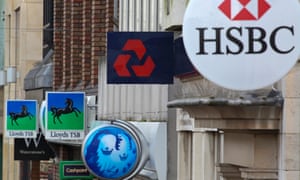
A package of measures intended to help customers save £92 a year by switching their bank accounts has been unveiled by the competition watchdog after a two-year investigation into the sector.
Consumer bodies immediately questioned whether the moves would be enough to break the stranglehold that the big four – Lloyds Banking Group, Royal Bank of Scotland, HSBC and Barclays – have on the market for current accounts and small businesses. Some had called for the big banks to be broken up.
The competition watchdog is keen for banks to adopt new techonology to enable customers to see the hidden charges, allowing them to shop around for the best account. This might eventually happen through the creation of a “digital app” or a sophisticated price comparison website but will need to be developed.
The CMA is relying on the technology behind applications such as Google Maps and Uber to increase competition by allowing information to be shared privately between customers and rival banks.
To tackle the £1.2bn a year the banking sector makes from unarranged overdraft charges, banks will be required to send alerts to customers going into the red and set a monthly cap on such charges.
The inquiry, first announced in July 2014 when the Labour party was vowing to create new banks, was carried out by the Competition and Markets Authority.
The measures are intended to kickstart competition in a sector where only 3% of personal and 4% of business customers switch to a different bank in any year.
“This is despite, for example, personal customers in Great Britain being able to save £92 on average per year by switching provider, with savings of around £80 a year on average available for small businesses,” the CMA said.
“Larger savings are available for overdraft users – for example, personal customers who are overdrawn for one or two weeks every month could save £180 per year on average,” the CMA said.
The big four control 77% of the current account market and more than 80% of small business accounts, and market shares that have changed little in recent years despite a number of investigations into the sector.
Alasdair Smith, who chaired the investigation and has faced criticism in the past for holding back from tough reforms, said: “We are breaking down the barriers which have made it too easy for established banks to hold on to their customers. Our reforms will increase innovation and competition in a sector whose performance is crucial for the UK economy.”
Alex Neill, director of policy and campaigns at consumer watchdog Which?, said the measures did not go far enough: “The steps outlined today, to provide customers with better information and an improved switching experience, are welcome. However it is questionable whether these measures will be enough, not only to increase competition but also to ensure banks deliver a better service for their customers.”
She added: “It is disappointing that the monthly charge cap is not actually a cap and banks will be allowed to continue to charge exorbitant fees for so called unauthorised overdrafts, rather than protect those customers that have been identified as among the most vulnerable.”
The use of free-if-in-credit banking – in which customers do not pay a fee for services provided they do not go overdrawn – is often criticised by rivals to the big four as they argue it makes it difficult for customers to know how much they are paying for their banking services.
Spanish-owned TSB – once part of Lloyds – wanted customers to be sent monthly bills. Paul Pester, chief executive of TSB, said: “The CMA has played right into the hands of the big banks and missed a golden opportunity to enable people across the UK to get a better deal from their banks.”
Diane Coyle, a professor at Manchester University and a former advisor to the Treasury, told the BBC that “not much is going to change” and that the watchdog was “relying on new technology to do the competition for us”.
“In the absence of the regulators actually looking at the structure of the industry seriously, I will be waiting for the Apples or the Googles to come along with a more compelling product,” she said.

No comments:
Post a Comment